A species
Lyme disease spirochaete
Borreliella burgdorferi
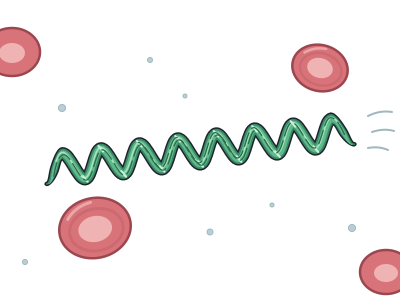
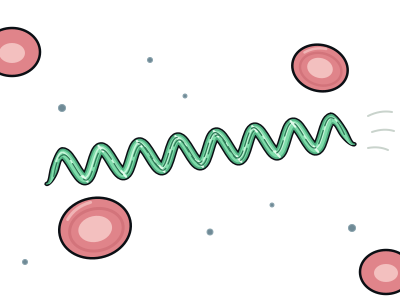
A corkscrew germ that swims by wriggling its whole body
You and the lyme disease spirochaete meet in the All life branch, shown at about 4.2 billion years ago (on 1 January, in a calendar from life's shared ancestor to today).
This tiny bacterium is shaped like a stretched-out corkscrew, and it swims in a way most bacteria can't. Many familiar bacteria push themselves along by spinning tails that stick out of the cell. This one keeps its tails tucked inside, under its outer skin. When they spin, its whole body ripples in a flat wave, and that wave drives it forward.
That wriggle lets it travel through thick, gel-like places, such as the material between body cells, where most other bacteria get stuck. A typical cell is about 10 micrometres long but only about 0.3 micrometres wide, far thinner than a human hair.
It does not live free in soil or water. Instead, it moves back and forth between ticks, such as blacklegged ticks, and wild animals such as mice. People are a dead end for it. An infected person almost never passes it back into the tick-and-animal cycle.
In people it causes Lyme disease. Early signs include fever, headache, tiredness and often a spreading rash. Most cases get better with antibiotics if they are treated early. In the USA, the disease is most common in the Northeast, the mid-Atlantic and the upper Midwest. This bacterium is also found in Europe.
No iron needed
Almost every other known living thing needs iron, but this bacterium doesn't. In a key protective enzyme it uses manganese where other living things use iron. That helps it get around the body's trick of starving germs of iron.
A straight chromosome
Most bacteria keep their main DNA in a ring, but this one's is a straight line. In 1997 it became one of the first bacteria to have its full set of DNA read.
Named after its finder
The species is named after Willy Burgdorfer, who found it in ticks and reported it in 1982.
Next to it on the tree
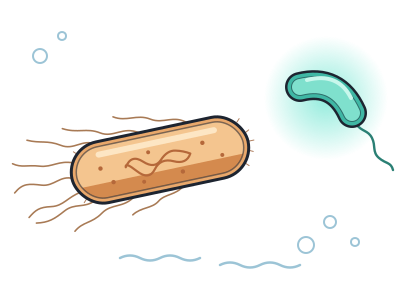
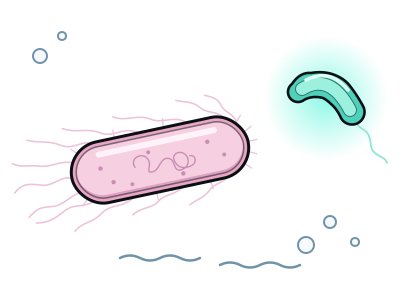
- ProteobacteriaThe most varied bacterial branch: gut dwellers, glowing squid partners, root helpers and our mitochondria's kin.
- Gut fibre-digesterA gut regular that breaks down plant fibre we cannot digest and shares the energy with us.
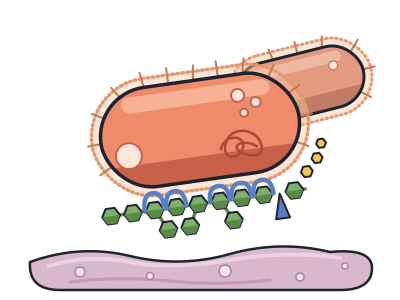
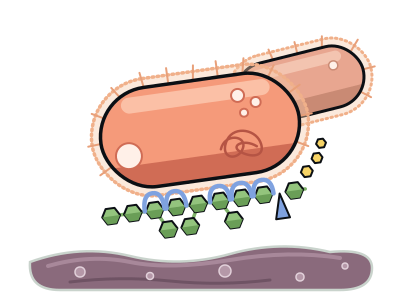
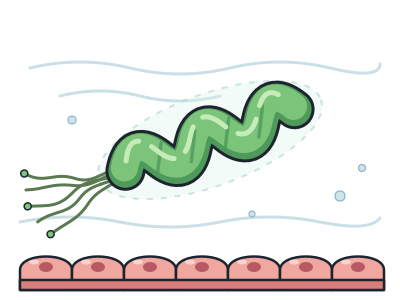
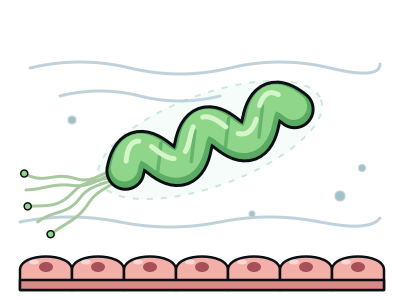
- Stomach ulcer bacteriumLives in the stomach's acid; a doctor drank it to prove it causes ulcers and later won a Nobel Prize.
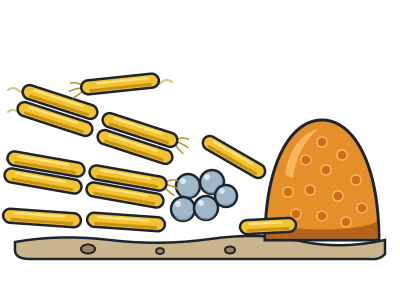
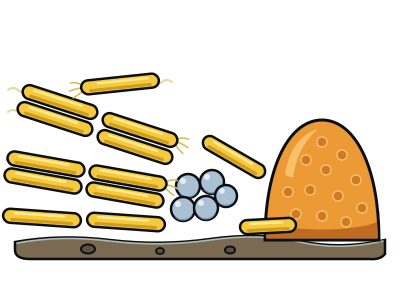
- Wolf-pack bacteriumHunts other microbes in swarms and, when food runs out, gathers by the thousand into tiny fruiting towers.
- Cable bacteriumThousands of cells link into centimetre-long living wires that carry electric current through sea mud.
- Mucus-eating gut bacteriumGrazes on the mucus lining your gut, and may help keep that lining healthy and thick.
- Rocket-fuel bacteriumMakes hydrazine, a rocket fuel, inside a special compartment, and quietly cleans nitrogen from sewage.