A species
Mucus-eating gut bacterium
Akkermansia muciniphila
A tiny gut bacterium that eats your gut's mucus, and may help keep it thick.
You and the mucus-eating gut bacterium meet in the All life branch, shown at about 4.2 billion years ago (on 1 January, in a calendar from life's shared ancestor to today).
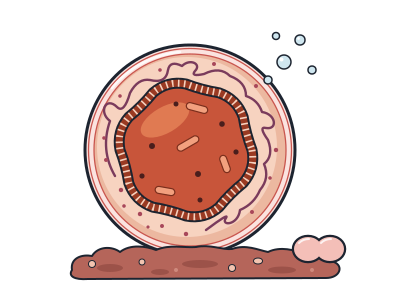
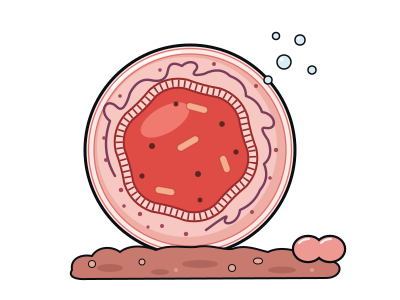
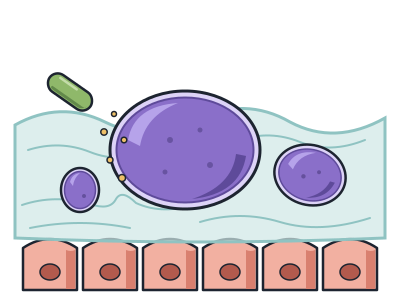
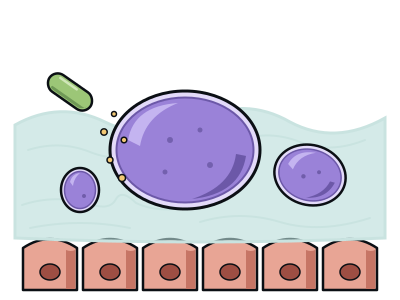
Your gut is coated in a slippery layer of mucus, and this tiny bacterium eats it. It can live on mucus alone and get all its food and energy from it. That sounds like bad news, but it eats only the mucus, not the cells of your gut wall. Here is the surprise: in mice, having it around goes with more mucus being made, a thicker mucus layer, and more of the proteins that seal the gut-lining cells together.
Each cell is a smooth little oval, about a thousandth of a millimetre across. It has no tail and cannot swim. It lives mainly in the large intestine, tucked into the mucus close to the gut wall, where there is very little oxygen. When it breaks mucus down, the leftover scraps feed other gut bacteria.
It is almost certainly inside you right now. It has been found in more than nine out of ten healthy adults tested. On the tree, it shares a big branch of bacteria with the gut fibre-digester and the stomach ulcer bacterium.
In a 2013 study, mice on a high-fat diet that were given this bacterium built up less fat, and their mucus barrier got stronger. But most of the evidence comes from mice, and having more of it is not always linked with better health.
Named after a scientist
Its first name honours the Dutch microbiologist Antoon Akkermans, and its second name means 'mucin-loving'. Mucin is the main ingredient of mucus.
Not just in humans
Bacteria like it have been found in the guts of animals from 15 of the 16 mammal groups tested, including elephants, horses, pigs and rodents.
Picked up as babies
One study found it in about 16 in every 100 one-month-old babies, rising to about 90 in every 100 by their first birthday.
Next to it on the tree
- ProteobacteriaThe most varied bacterial branch: gut dwellers, glowing squid partners, root helpers and our mitochondria's kin.
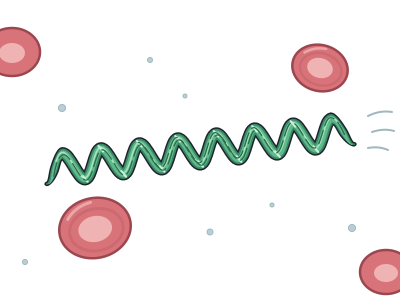
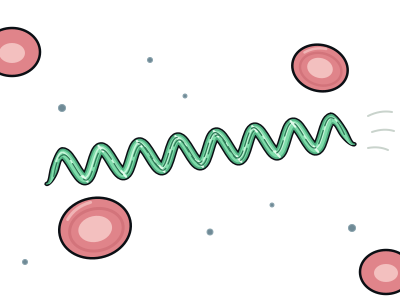
- Lyme disease spirochaeteA corkscrew-shaped bacterium that swims by twisting its whole body; ticks carry it between animals.
- Gut fibre-digesterA gut regular that breaks down plant fibre we cannot digest and shares the energy with us.
- Stomach ulcer bacteriumLives in the stomach's acid; a doctor drank it to prove it causes ulcers and later won a Nobel Prize.
- Wolf-pack bacteriumHunts other microbes in swarms and, when food runs out, gathers by the thousand into tiny fruiting towers.
- Cable bacteriumThousands of cells link into centimetre-long living wires that carry electric current through sea mud.
- Rocket-fuel bacteriumMakes hydrazine, a rocket fuel, inside a special compartment, and quietly cleans nitrogen from sewage.