A species
Coconut palm
Cocos nucifera
A palm whose seed can drift at sea for months and still sprout on a faraway beach.
You and the coconut palm meet in the Eukaryotes branch, shown at about 1.8 billion years ago (on 28 July, in a calendar from life's shared ancestor to today).
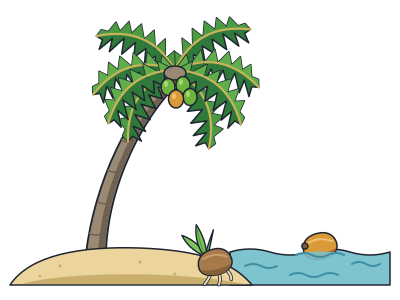
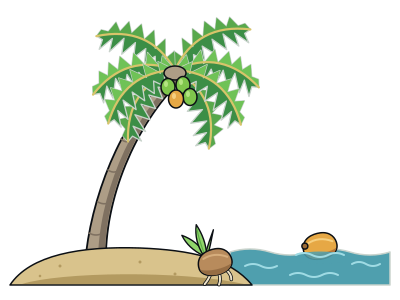
A coconut is built for a sea voyage. Under its smooth skin is a thick, hairy husk wrapped around a hard shell, and the whole thing floats. It may stay afloat for years, much longer than the seed inside stays alive. In one small test in Hawaii, coconuts were soaked in seawater for up to four months, and most of them still grew into healthy plants.
Coconuts sometimes wash up on beaches in Ireland, sometimes already sprouting. Cold Atlantic water may slow down sprouting, which could help them survive the long trip.
Floating alone did not spread coconuts around the world, though. Computer models of winds and ocean currents suggest coconuts could not cross the Pacific by themselves. People carried them across the seas, and that is largely why the palms now grow across the tropics.
On the tree, the coconut sits in a group with grasses, bananas, pineapples and ginger, and it is a fellow palm of the date palm. Surprisingly, its closest living relatives are South American palms, such as the queen palm. A coconut palm can grow about 30 metres tall, as high as a 10-storey building, with leaves about as long as a large car.
Named for a face
The word 'coco' comes from an old Portuguese word for 'head' or 'skull', because the three marks on the shell look like a face.
Not really a nut
Despite its name, a coconut is not a true nut. It is a stone fruit, the same kind of fruit as a peach or a cherry.
One working eye
Of the three 'eyes' on the shell, two are plugged. The tiny baby plant sits just under the one that works, and its shoot pushes out through it.