A species
Holiday cactus
Schlumbergera truncata
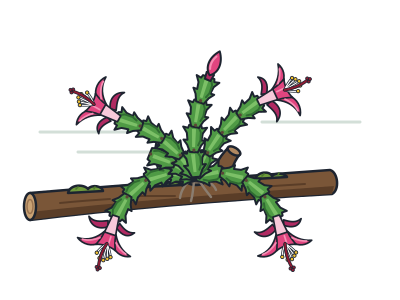
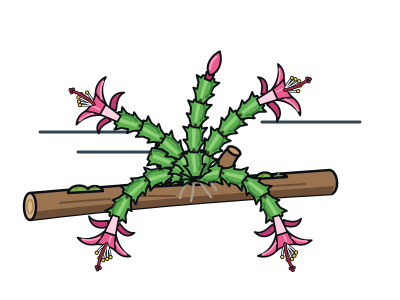
A rainforest cactus that lives in the trees and flowers indoors as winter nights grow long.
You and the holiday cactus meet in the Eukaryotes branch, shown at about 1.8 billion years ago (on 28 July, in a calendar from life's shared ancestor to today).
It looks nothing like a desert cactus, but this plant is a true cactus. It is a relative of the giant saguaro and the prickly pear. In the wild it lives on the branches of trees, in misty rainforest in the coastal mountains of south-eastern Brazil. Its roots grip the bark, and it grows in shade or dappled light under the leafy canopy, not in full sun.
It is not a parasite and takes nothing from its tree. It gets water and food from rain and rotting leaves instead. Like every cactus, it has tiny growing points called areoles. Its red or pink flowers grow from these, right at the tips of its flat green stems. The tube-shaped flowers are thought to be pollinated by hummingbirds, and birds spread its seeds.
Indoors, it is famous for blooming around the winter holidays. But it doesn't know the date. It makes flower buds when the nights become long and cool. In northern countries that happens around October and November, so people link it with Thanksgiving and Christmas. In its home in Brazil, and in Australia, it flowers in autumn instead, around May. Even a streetlight shining in at night can stop it blooming.
Not quite the Christmas cactus
This species is usually sold as the Thanksgiving cactus. The 'true' Christmas cactus is a hybrid that a gardener called William Buckley bred from this plant and a close relative by the early 1850s.
In trouble in the wild
Wild plants grow in only about ten small patches, all near cities. The species is listed as Vulnerable because of illegal collecting and spreading cities, so wild plants must never be picked.
A family heirloom
Holiday cacti can live for decades, so families often pass the same plant down from grandparents to grandchildren.