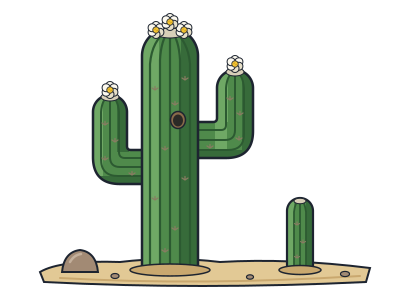
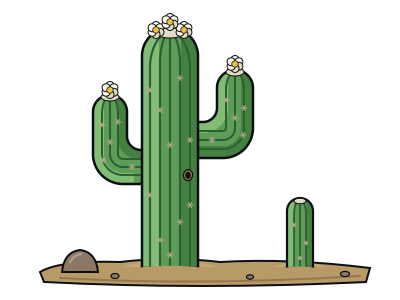
A species
Saguaro cactus
Carnegiea gigantea
A desert giant that stores more than a tonne of water and takes its time growing arms.
You and the saguaro cactus meet in the Eukaryotes branch, shown at about 1.8 billion years ago (on 28 July, in a calendar from life's shared ancestor to today).
Imagine a plant that is also a water tank. A big saguaro, fully soaked after rain, can weigh about 1.5 to 2 tonnes, as heavy as a large car, and most of that is water. Yet it is in no hurry. It usually grows its first arms at about 60 to 75 years old, and in drier places it can take up to 100 years.
Its secret is a spongy inside and a pleated skin. When rain falls, a wide net of shallow roots, spreading up to about 30 metres, soaks up water fast. The pleats then stretch out like an accordion as the plant fills. A ring of woody ribs inside holds up the heavy trunk.
You might guess that a cactus is related to other spiny desert plants. In fact, it belongs to a big group of flowering plants that also includes carnations, beetroot and meat-eating plants such as the Venus flytrap and sundews.
Saguaros grow wild only in the Sonoran Desert, mainly in southern Arizona and Sonora in Mexico. Their creamy-white flowers open at night, when bats come to drink the nectar, and stay open into the next day for bees and birds.
Tallest with no arms
The tallest saguaro ever recorded was about 24 metres tall and had no arms at all. It grew near Cave Creek, Arizona, and fell over in 1986.
Millions of seeds, few winners
One saguaro may make 20 to 40 million tiny black seeds in its life, but perhaps only 1 or 2 of them grow into adults.
Woodpecker 'boots'
When woodpeckers dig nest holes in a saguaro, the cactus seals the wound with sap that hardens into a tough shell called a 'saguaro boot'. These boots can last long after the cactus has died and rotted away.