A species
Camembert mould
Penicillium camemberti
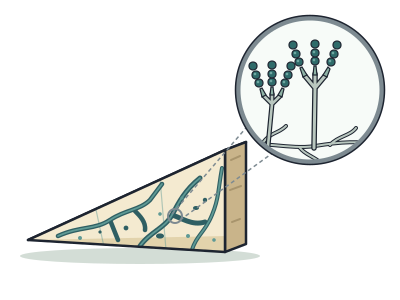
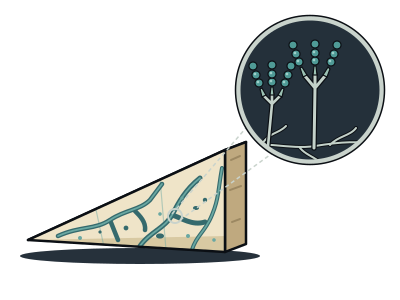
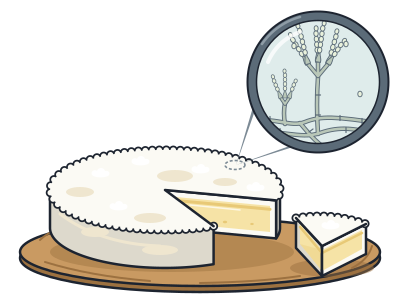
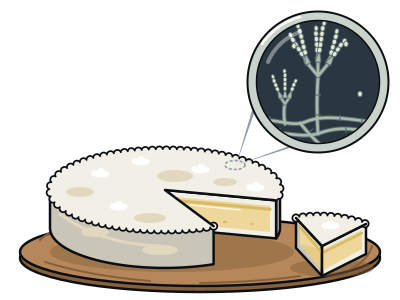
The fuzzy white rind on Camembert and Brie: a mould that cheesemakers grow on purpose.
You and the camembert mould meet in the Fungi and animals branch, shown at about 1.3 billion years ago (on 10 September, in a calendar from life's shared ancestor to today).
That soft white fuzz on Camembert and Brie doesn't mean the cheese has gone off. It's a living mould, and cheesemakers grow it there on purpose. They spray each young cheese with water that carries the mould. Then they leave it to ripen for at least three weeks. The mould forms a velvety coat about 3 mm thick and helps give the cheese its flavour.
Here's the surprise: this mould has been domesticated. Scientists compare the way people shaped it to the way wolves became dogs. Compared with their wild relatives, the cheese moulds are whiter and grow faster in ripening cellars. They make little or no harmful toxin, and they help stop unwanted moulds from spreading.
Its closest relative is another cheese mould, which can be found naturally in raw milk. Both belong to the same mould group as the blue mould in blue cheeses and the mould that gave us penicillin. The blue cheese mould grows inside the cheese. This one grows only on the outside, where it can get air.
Camembert wasn't always pure white. A single white strain was picked for Brie in 1898 and for Camembert in 1902. Even so, until the 1950s many rinds were grey or green, and sometimes orange-tinged. After that, makers switched to the pure white strain, which is now used around the world. It shows no sign of breeding sexually, so it has been copied again and again from old mould, and it now struggles to make spores. Scientists suggest its close relative could take its place if needed.
Named after a paintbrush
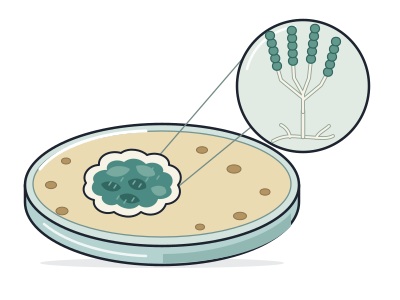
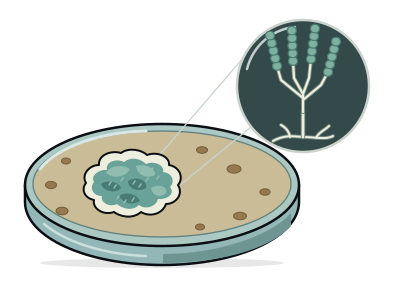
The name of its mould group comes from the Latin word for a painter's brush. Under a microscope, its chains of spores look like a tiny brush or broom.
Too warm inside us
It grows best at about 20–25 °C. It can't grow at all at human body temperature, which is about 37 °C.
Two names
An American mould scientist, Charles Thom, formally described it in 1906. Home cheesemakers can also buy it under another name, Penicillium candidum.
Next to it on the tree
- Penicillin mouldA blue-green mould on a lab dish led to penicillin, the first widely used antibiotic.
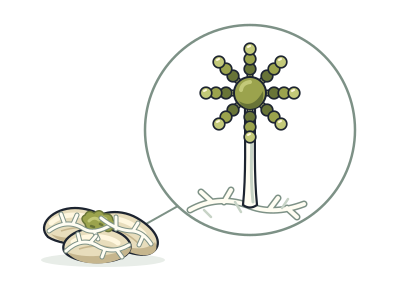
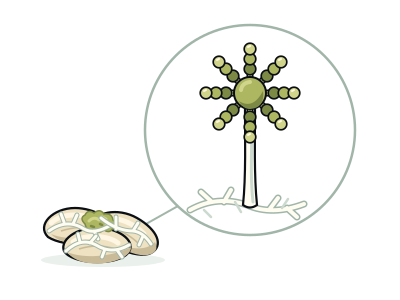
- Koji mouldTamed in Japan over a thousand years ago to make soy sauce, miso and sake.
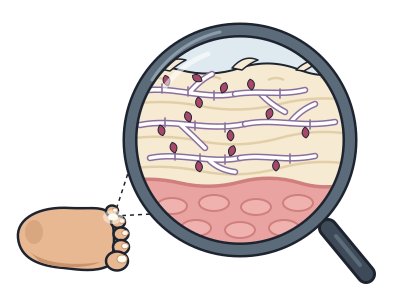
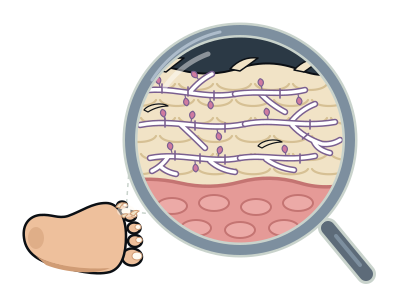
- Athlete's foot fungusFeeds on the dead outer layer of skin, causing itchy feet; easy to treat.
- Blue cheese mouldMakes the blue-green veins and sharp taste of Roquefort, Stilton and Gorgonzola.