A species
Barn swallow
Hirundo rustica
Catching insects in flight, travelling between continents.
You and the barn swallow meet in the Amniotes branch, shown at about 320 million years ago (on 4 December, in a calendar from life's shared ancestor to today).
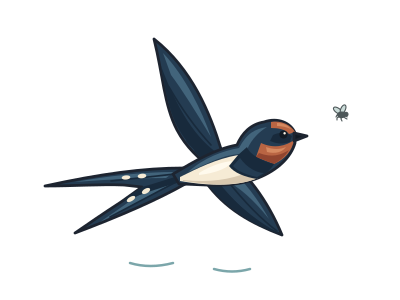
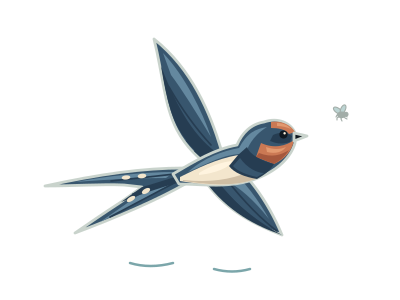
Barn swallows catch insects in mid-air, and many travel between continents each year. These flying hunters belong to the perching birds, the same broad group as sparrows and ravens. Watch them hunting just above a field or pond: they catch flies, flying beetles, moths and other insects without landing.
Many barn swallows that breed in Britain spend the northern winter in South Africa. Their yearly travels link Europe and Africa, but not every bird makes that journey. A small number sometimes stay in Britain through winter. The first returning swallows arrive there in March, and some remain into October.
When it is time to nest, both parents build with pellets of mud, often mixed with grass stems. They shape an open cup and line it with grass and feathers. Barns are not their only nesting places: bridges and other sheltered structures also provide support. An old nest may be cleaned and repaired for another season.
A drink on the wing
Barn swallows can drink while flying, dipping towards the water to scoop up a mouthful.
Extra helpers
Parents sometimes get help feeding their chicks. Helpers are usually young from an earlier batch of eggs, though unrelated young birds may help too.
A record, not an average
The oldest recorded North American barn swallow was at least ten years old. That is a record, not a typical lifespan.
Next to it on the tree
- Eurasian skylarkRises high over fields, singing nonstop while it hangs in the sky.
- Eurasian reed warblerWeaves its nest around reed stems; cuckoos often trick it into raising their chicks.
- Eurasian blackcapSome now winter in British gardens rather than Spain, a migration change seen in real time.
- Long-tailed titA tiny ball of feathers with a long tail that builds a stretchy nest of moss and spider silk.