A species
Mermaid's wineglass
Acetabularia acetabulum
A single cell as tall as your finger, topped with a tiny umbrella.
You and the mermaid's wineglass meet in the Eukaryotes branch, shown at about 1.8 billion years ago (on 28 July, in a calendar from life's shared ancestor to today).
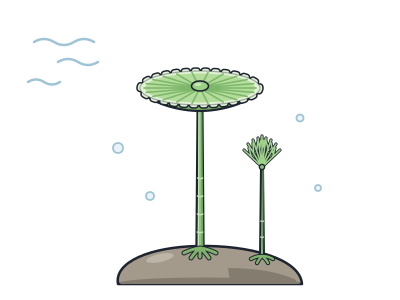
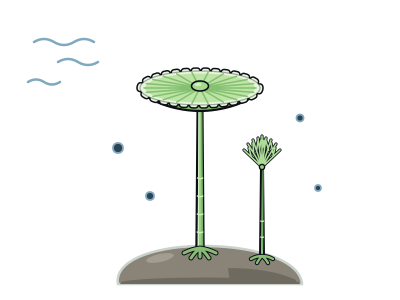
Picture a tiny pale green umbrella on a thin stalk, about as tall as your finger. Now picture the whole thing as just one cell. This green alga usually stands about 4 to 10 cm tall, which is huge for a single cell. At the bottom, a root-like base grips a rock. Above it rises a long, thin stalk, often about 5 cm long, and on top sits a round cap about 1 cm across.
On the tree of life it belongs to the green plants, the same big group as trees and grass. Within that group it sits among the green seaweeds and pond algae, alongside sea lettuce, Chlamydomonas and Volvox. It makes its own food from sunlight. Even though it is only one cell, it holds several million chloroplasts, the tiny green parts that capture light.
For most of its life the whole cell has just one nucleus, and it sits safely down in the base. If the cap is cut off, the cell can grow a new one. From the 1930s to the 1950s, a scientist named Joachim Hämmerling cut up these cells and joined them to cells of a related species with a different-shaped cap. In the end, the new caps took the shape of the species that gave the nucleus. This showed that the nucleus holds the instructions for building the cell.
It lives in rock pools and shallow water in the Mediterranean Sea and the nearby Atlantic, often growing in groups on stones.
Darker by day, paler by night
Its chloroplasts move every day. In daylight they spread out and the stalk looks evenly dark green. At night they bunch together and the stalk looks paler.
A sea slug that borrows its sunlight power
A small sea slug, about 12 mm long, eats this alga in spring and summer. It keeps the chloroplasts it swallows working inside its own body for about 45 days, so it can get energy from sunlight.
One nucleus becomes thousands
When it is ready to breed, its single nucleus divides again and again into thousands. These move up into the cap, and by late summer the cap breaks up and releases thousands of sex cells into the sea.
Next to it on the tree
- ChlamydomonasA single green cell that swims with two whip-like tails and steers using a red eyespot.
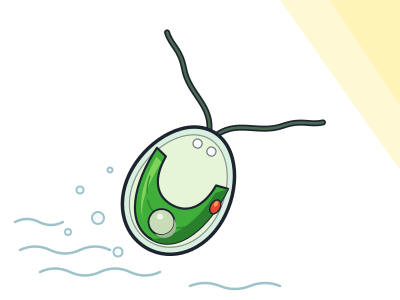
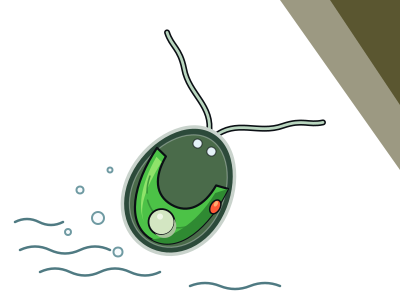
- VolvoxThousands of cells form a spinning green ball, with baby balls growing inside.
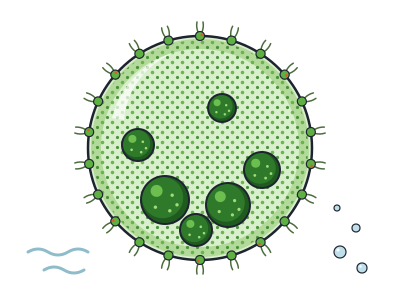
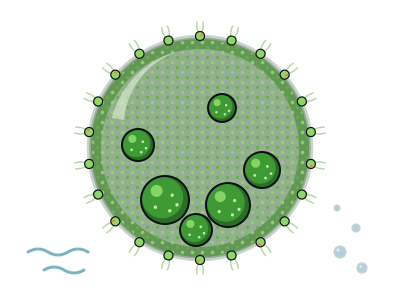
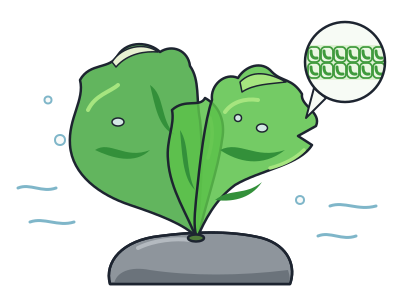
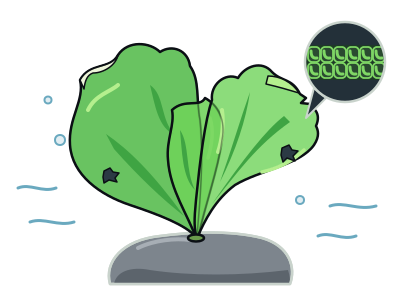
- Sea lettuceA seaweed only two cells thick that you can find on almost any rocky shore.
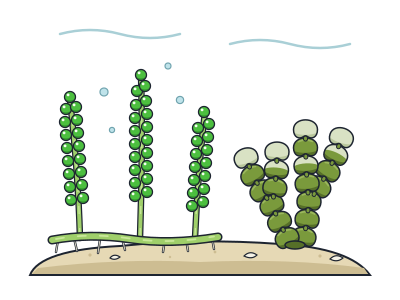
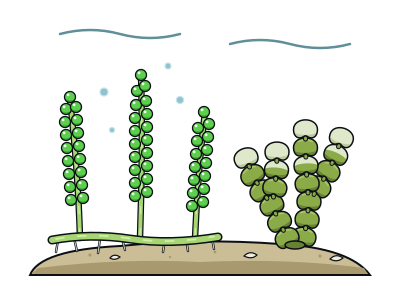
- Bubble and grape seaweedsSeaweeds that can grow a metre long while being one giant cell with millions of nuclei.
- ChlorellaA single green ball of a cell, sold as a health powder and studied as space-station food.
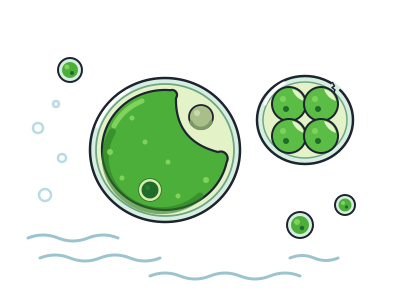
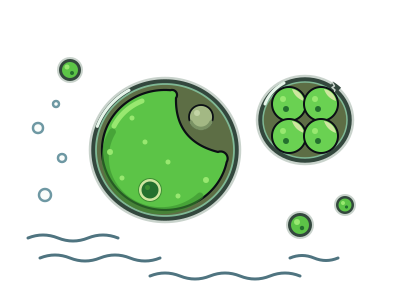
- OstreococcusThe smallest known free-living cell with a nucleus, about a micron across.
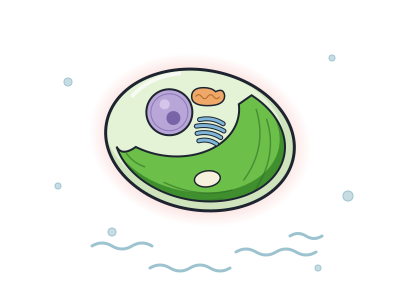
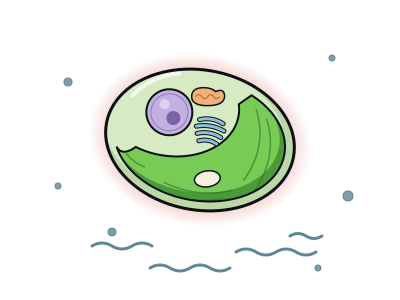
- Marimo moss ballVelvety green balls that roll on lake floors in Japan and live as pets in jars.