A species
Yeti crab
Kiwa hirsuta
A shaggy white deep-sea crustacean that may grow its own food on its arms.
You and the yeti crab meet in the Two-sided animals branch, shown at about 580 million years ago (on 11 November, in a calendar from life's shared ancestor to today).
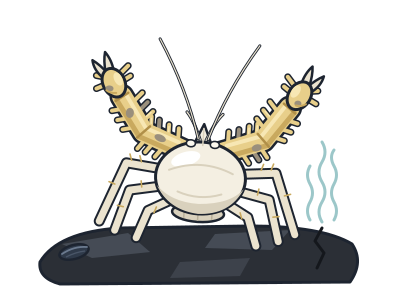
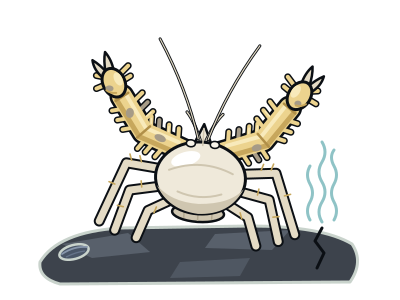
Deep on the floor of the South Pacific lives a white animal whose arms look like they are wrapped in fur. Its long claws and legs are covered in pale yellow bristles that feel a bit like a toothbrush. Thick clumps of thread-like bacteria grow among those bristles. Scientists think the crab may 'farm' these bacteria for food, but no one has yet seen this species eat them.
Despite its name, it is neither a true crab nor a true lobster. It is a kind of squat lobster, with a flattish body and its tail tucked underneath, like a small lobster folded in half. That puts it in the same wider group as hermit crabs and king crabs, and scientists have called it a distant relative of hermit crabs.
It lives about 2,200 metres down, around hydrothermal vents on fresh lava flows, where warm water seeps out of the rock. No sunlight reaches that far down. Its eyes are tiny and have no colour, and scientists think it is blind.
Scientists in the deep-sea submarine Alvin found it in 2005, about 1,500 km south of Easter Island. They saw many of these crabs hiding under or behind rocks. Some were eating mussels that had been cracked open when the submarine landed, so it may eat other food too.
Named after a goddess
Its first name comes from a goddess of shellfish in Polynesian mythology. Its second name means 'hairy' in Latin.
A whole new family
It was so unlike other known crustaceans that scientists made a new family for it. One research institute said it was only the second new family of deep-sea crabs found since the mid-1800s.
Dancing relatives
A related yeti crab from off Costa Rica waves its hairy claws back and forth in the water seeping from the seafloor. It then combs the bacteria off with bristly mouthparts and eats them.