A species
Red king crab
Paralithodes camtschaticus
A giant spiny crab of cold northern seas, with hermit crabs in its family tree
You and the red king crab meet in the Two-sided animals branch, shown at about 580 million years ago (on 11 November, in a calendar from life's shared ancestor to today).
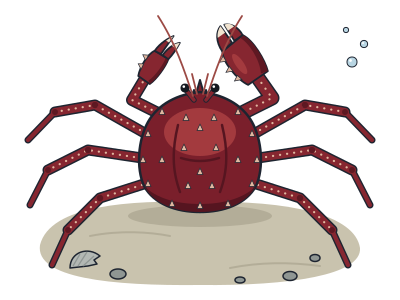
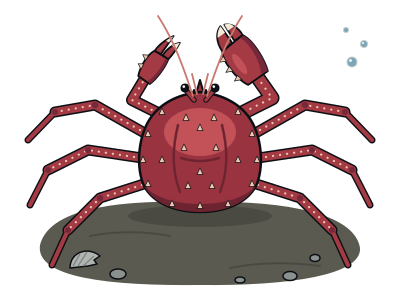
Imagine a crab whose spiny legs stretch about 1.5 metres from tip to tip. That is nearly as wide as a grown-up is tall. It is one of the biggest crabs that people fish for. A record male weighed about 11 kilograms, roughly as heavy as a full bucket of water.
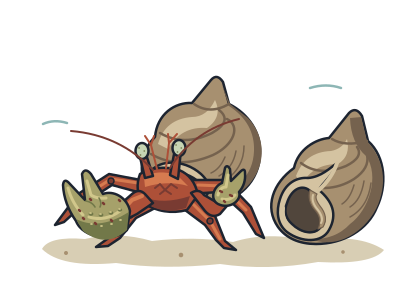
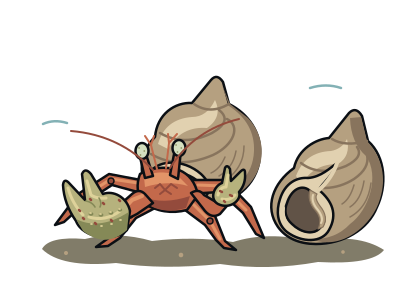
The surprise is its family. Despite its crab shape, the red king crab is not a 'true crab' like the shore crab. Studies of body features and DNA show that king crabs evolved from hermit crab ancestors. Most hermit crabs hide their soft bodies inside borrowed shells. Over millions of years, king crabs gave up the borrowed shell and took on a full crab shape. A clue still remains: the tail flap tucked under a female's body is lopsided, like a hermit crab's.
This crab walks the seabed of the cold North Pacific, from Alaska and British Columbia across to eastern Russia and northern Japan. The water there is cold, sometimes just below 0 °C. Sharp spines cover its shell and legs. Its bigger claw, usually the right one, crushes clams and mussels, while the smaller claw handles food more gently. In the 1960s, Soviet scientists also brought it to the Barents Sea. It has since spread along the coast of northern Norway, where it is not a native animal.
Hidden legs
It really has ten legs, but you usually see only eight. The tiny fifth pair is tucked away under the back of the shell and is used for reproduction.
Huge families
A female can carry about 50,000 to 500,000 eggs. The babies drift in open water for 2 to 3 months before settling on the seabed as tiny crabs.
Long-distance walkers
Adult males near Kodiak, Alaska, travel up to about 160 kilometres every year, moving between the coast and deeper water.