
A species
Water clover
Marsilea quadrifolia
It looks like a lucky four-leaf clover, but it is a fern that grows in shallow water.
You and the water clover meet in the Eukaryotes branch, shown at about 1.8 billion years ago (on 28 July, in a calendar from life's shared ancestor to today).
At first glance, this little plant looks like a lucky four-leaf clover. Each leaf ends in four fan-shaped leaflets arranged in a cross. But it is not a clover at all. It is a fern, and it grows in shallow water. True clovers are flowering plants in the pea family, and they usually have three leaflets. Water clover has no flowers or seeds. Like other ferns, it makes spores instead.
Its close relatives are other water ferns, including the mosquito fern. The two look nothing alike. Mosquito fern floats and has tiny scale-like leaves, while water clover is rooted in mud. Among ferns, though, only their two families make two kinds of spores, one large and one small.
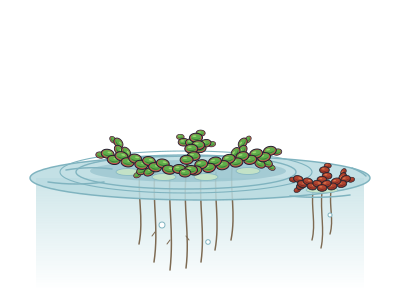
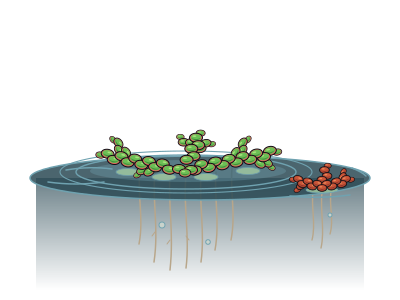
Water clover spreads by thin stems that creep through the mud. Each leaf grows on its own long stalk. In deeper water the leaves float on the surface. In shallow water or on mud they can stand upright. New leaves start as tight spirals, called fiddleheads, and slowly unroll.
It grows in ponds, marshes, ditches and rice fields from Europe to Asia. In Europe it is becoming rarer as wetlands dry out. In 1862 it was brought to a lake in Connecticut, USA. It is now listed as an invasive plant there.
Sleepy leaves
Leaflets held up in the air can fold together at night and open again in daylight.
Spores that wait
Its spores grow in small, hard, bean-like capsules. In its family, capsules kept in plant collections for more than 130 years have still sprouted.
An ancient family
The water clover family goes back to the Late Triassic, when early dinosaurs lived, about 237 to 201 million years ago.