A species
Mosquito fern
Azolla filiculoides
A fingertip-sized floating fern whose ancient relatives may have helped cool the planet.
You and the mosquito fern meet in the Eukaryotes branch, shown at about 1.8 billion years ago (on 28 July, in a calendar from life's shared ancestor to today).
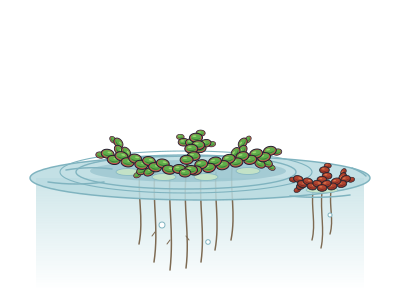
This floating fern is so small it could sit on your fingertip. Even so, huge mats of its close relatives may once have helped cool the whole planet. It looks more like moss than a fern. Its leaves are only about 2 mm long and overlap like roof tiles. But it is a true fern, a relative of bracken and tree ferns.
About 50 million years ago, the Arctic Ocean was mostly cut off from other seas. Fresh water from rivers and rain lay on top of it. Fossils show that huge numbers of ferns related to the mosquito fern ended up there, probably over hundreds of thousands of years. Scientists call this the Azolla event. One idea is that the ferns pulled carbon dioxide out of the air and took it down to the seabed when they died. That may have helped Earth change from a hothouse into today's colder world, with ice at the poles.
Its secret is a partner. A small pocket in each leaf is home to a blue-green bacterium. The bacterium turns nitrogen from the air into a form the fern can use as fertiliser. The fern passes this partner straight on to its young, so every new plant starts with its own supply. No other known plant does this. Rice farmers in Asia have used these ferns to fertilise their paddy fields for more than 1,000 years.
First ferns to be read
In 2018 it became one of the first two ferns to have their genomes read, in a project paid for partly by crowd-funding. Its genome is small for a fern: about 0.75 billion DNA letters. The average fern has about 12 billion.
Speedy grower
In good conditions, mosquito ferns can double their mass in just a few days. That is how one plant can turn into a mat that covers a whole pond.
A misleading name
The name comes from the idea that its thick mats keep mosquitoes away. The mats do make life harder for mosquito larvae, but it is a myth that no mosquito can lay eggs through them.