A species
Soft tree fern
Dicksonia antarctica
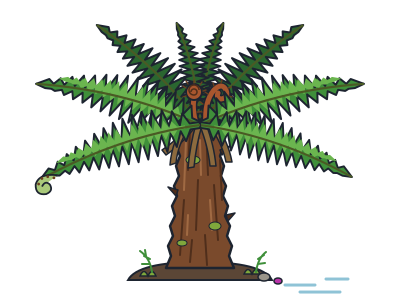
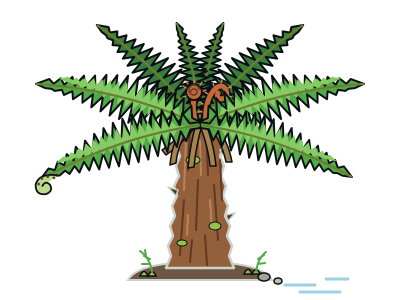
A fern that grew a trunk and opens giant fronds like a green umbrella.
You and the soft tree fern meet in the Eukaryotes branch, shown at about 1.8 billion years ago (on 28 July, in a calendar from life's shared ancestor to today).
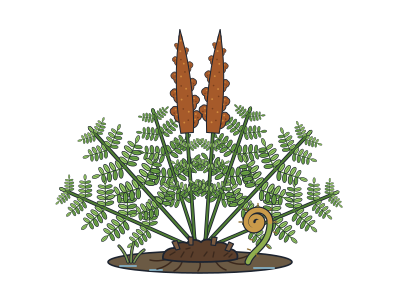
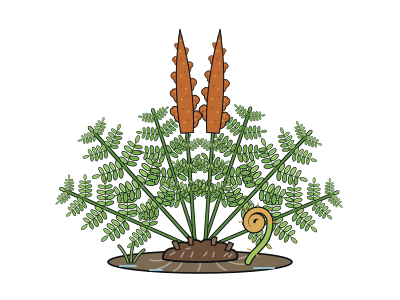
Picture a fern, the kind that grows low on a forest floor. Now lift it up onto a shaggy brown trunk, often taller than a house ceiling. That is the soft tree fern. A crown of huge, feathery fronds spreads out from the top like a green umbrella. Its biggest fronds can be up to about 4 metres long, nearly as long as a car.
It is a fern through and through, a relative of the bracken that grows wild in many countries. But its trunk has no wood. It is an upright stem wrapped in a thick, soft mat of tiny brown roots and old frond stubs. A hard outer layer of the stem and those tangled roots hold it up.
New fronds start as tight coils covered in soft reddish-brown hairs. They slowly unroll from the centre of the crown as old fronds die back. The trunk grows only about 3 to 5 centimetres a year, about the length of a paperclip. So a tall fern may be well over a hundred years old.
It grows in rainforests and wet eucalypt forests, especially in shady gullies and along creeks. It is found in south-eastern Australia, from the far south-east of Queensland down to Tasmania. Like all ferns, it has no flowers or seeds. It spreads by dust-like spores made in tiny brown dots under its fronds.
Back from the ashes
After bushfires in Victoria in 2009 burnt off all their fronds, the tree ferns studied grew new ones within about 1 to 4 months.
A trunk full of guests
A study of 120 wild tree ferns in Tasmania found 97 kinds of mosses, small ferns and similar plants growing on their trunks.
Not from Antarctica
Its scientific name includes the word 'antarctica', but here it just means 'southern'. It is not an Antarctic plant at all.