A species
Royal fern
Osmunda regalis
A stately fern from a family that has barely changed in 180 million years
You and the royal fern meet in the Eukaryotes branch, shown at about 1.8 billion years ago (on 28 July, in a calendar from life's shared ancestor to today).
The royal fern comes from a family that has hardly changed in a very long time. Scientists studied a fossil stem from this family that is about 180 million years old. It was found in southern Sweden. It was so well preserved that they could see the centres of its cells and even chromosomes. Some cells had been caught in the middle of dividing. The cell centres were the same size as those in living members of the family. That suggests the family's genetic material has stayed about the same size ever since.
Its family is the sister group to all other typical ferns, including the soft tree fern, the water ferns and the polypod ferns. That makes it the earliest branch of the typical ferns that is still alive today.
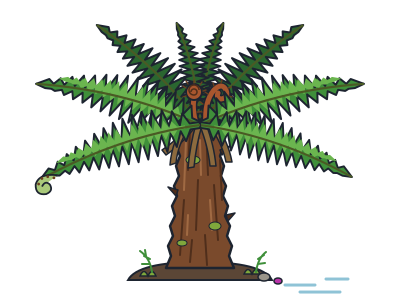
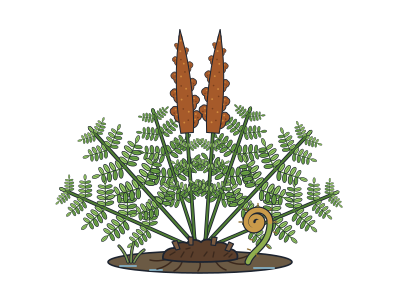
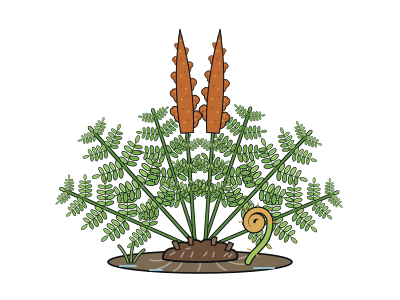
It is a big fern, often about 1.5 to 2 metres tall, which is about as tall as an adult, or a bit taller. Leafy outer fronds spread outwards. Upright inner fronds carry rust-brown clusters of spore cases at their tips, like tiny bunches of grapes. They look like flowers, but ferns never flower, and the spores inside are green.
In Britain and Ireland it grows on wet heathland and bogs, and in wet woods and ditches. The fronds turn red-brown in autumn, then die back for winter.
Victorian fern craze
In Victorian times, huge numbers of royal ferns were dug up for gardens and for 'osmunda fibre' (their root mat, used to grow orchids). Together with the loss of its wild homes, this made the plant decline. It is now listed as Least Concern in Britain and Ireland.
Unwelcome abroad
In New Zealand the royal fern is an introduced pest plant. It has been growing wild there since about 1890, probably after being brought in for gardens or for growing orchids.
A small family
The royal fern family is small, with only about 18 to 25 living species.