A species
Taro
Colocasia esculenta
A tropical food plant with giant leaves that water simply rolls off
You and the taro meet in the Eukaryotes branch, shown at about 1.8 billion years ago (on 28 July, in a calendar from life's shared ancestor to today).
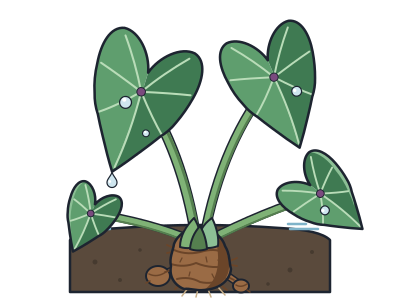
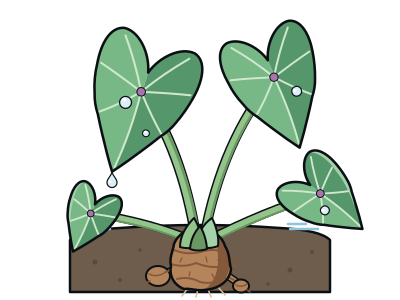
Taro is grown across the tropics for its starchy underground part. It looks like a root, but it is really a corm, which is a swollen stem base. A big one can weigh up to about 4 kg, as much as four bags of sugar. Its soft flesh is usually white and is boiled or fried. The leaves are cooked as a vegetable in soups and sauces.
The leaves are huge, like elephant ears. They can be up to about 90 cm long, and each one sits on its own long stalk. Pour water on a leaf and it forms shiny round drops that roll off. Under a powerful microscope, the surface shows a honeycomb of tiny five- and six-sided cells with flaky walls. Together these trap a layer of air, so each drop touches the leaf at only a few points.
Taro belongs to the arum family. It shares that family with the titan arum, the Swiss cheese plant and watermeal. Taro rarely flowers, but when it does, you can see the family likeness: a spike wrapped in a greenish or yellow hood, the same basic design most arums use.
It grows best where it is warm and very wet, and copes with flooded, soggy soil. Farmers grow it both in flooded paddies and in drier fields on higher ground.
An ancient crop
In the highlands of New Guinea, scientists found taro starch on stone tools about 10,000 years old, so people there were digging up taro even then. The site, Kuk Swamp, is thought to be one of the places where people worked out farming on their own.
Never eat it raw
Every part of raw taro has tiny needle-shaped crystals that sting the mouth and throat and can make them swell. Cooking it properly makes it safe.
Copying the leaf
Researchers in India copied the honeycomb pattern on taro leaves to make an artificial surface that repels water. They suggested that surfaces like it might one day help collect water from fog.
Next to it on the tree
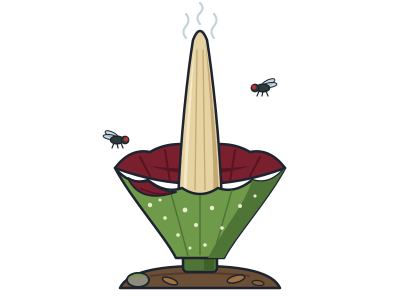
- Titan arumA giant flower spike up to three metres tall that smells like rotting meat to lure flies.
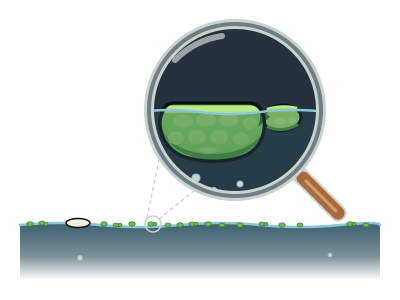
- WatermealThe smallest flowering plant on Earth, a green speck smaller than a grain of rice.

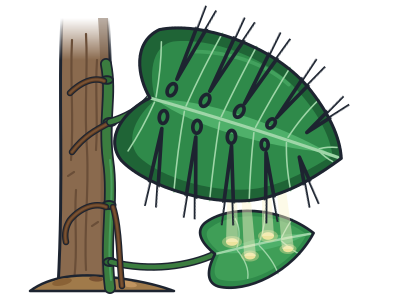
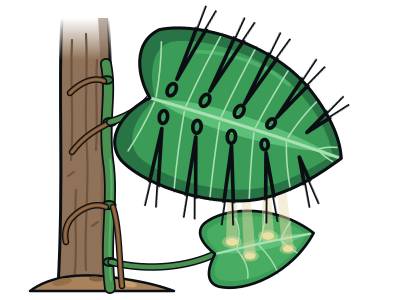
- Swiss cheese plantThe house plant with holey leaves, which may let wind and dappled light through in the rainforest.