A species
Swiss cheese plant
Monstera deliciosa
The house plant with holes in its leaves, and nobody knows for sure why
You and the swiss cheese plant meet in the Eukaryotes branch, shown at about 1.8 billion years ago (on 28 July, in a calendar from life's shared ancestor to today).
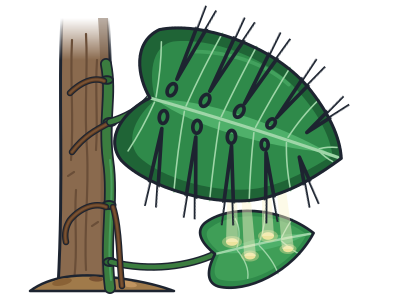
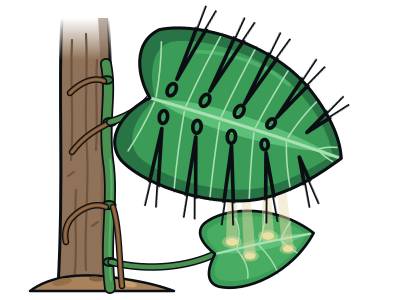
The Swiss cheese plant is famous for its holey leaves. In its rainforest home, the holes may let strong wind pass through and let patches of light fall onto the leaves below. Nobody knows for sure. Another idea comes from a maths model: holes let a leaf spread over a wider area, so it is more likely to catch the moving spots of sunlight that flicker through the trees.
The holes are not damage. They form while the leaf is still tiny, only a millimetre or two long, when small patches of cells die off in a planned way. Young plants have solid leaves. Holes and splits appear as the plant grows older.
In the wild, from southern Mexico to Panama, it is a climber. It grips tree trunks with thick, cord-like roots and can climb to about 20 metres, roughly as tall as a six-storey building. Grown-up leaves can be nearly a metre long.
On this tree it sits in the arum family, alongside taro, titan arum and watermeal. Like most plants in that family, it contains tiny needle-like crystals. Every part of the plant has them. If the leaves, stems or unripe fruit are chewed, they can make the lips, mouth and throat burn and swell.
A fruit salad in one fruit
Its fruit looks like a green corn cob covered in six-sided scales. It takes more than a year to ripen. When it is ripe, the scales lift off to show soft flesh that tastes like a mix of banana and pineapple. That is why it is also called the fruit salad plant.
Monstrous and delicious
Its scientific name means roughly 'monstrous' and 'delicious'. The first part refers to the strange holey leaves. The second refers to the tasty ripe fruit.
Roots for rope
People have used its long hanging roots as ropes in Peru and woven them into baskets in Mexico.