A species
Immortal jellyfish
Turritopsis dohrnii
A grown-up jellyfish with a way back to youth
You and the immortal jellyfish meet in the Animals branch, shown at about 700 million years ago (on 1 November, in a calendar from life's shared ancestor to today).
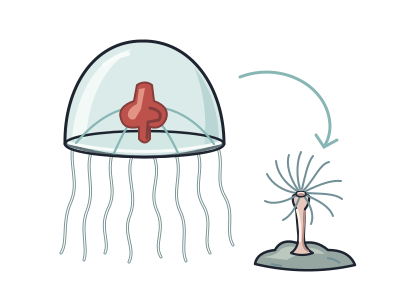
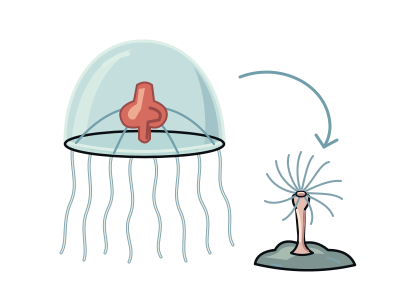
When injured or short of food, the immortal jellyfish can turn back into a polyp: an earlier body form that stays attached to a surface. It does not become an egg or just a smaller swimming jellyfish. This remarkable animal belongs to the same branch of the family tree as hydras and the Portuguese man o’ war, despite their very different shapes.
The change transforms its whole body. Its bell-shaped body shrinks, its tentacles are absorbed, and it stops swimming. It becomes a small attached blob, from which a colony of polyps develops. That colony can bud off new swimming jellyfish carrying the same inherited information as the original adult.
This can happen even after the jellyfish has grown up and reproduced. It can also happen repeatedly, rather than offering just one second chance. But its name needs a warning: “immortal” does not mean impossible to kill. Predators and infections can still end its life.
A red centre
The swimming jellyfish has a transparent body with a conspicuous red digestive centre.
The usual beginning
Its ordinary life cycle starts with a fertilised egg and a swimming young stage called a larva.
Known since 1883
Scientists formally described the species in 1883, long before its life-cycle reversal became famous.
Next to it on the tree
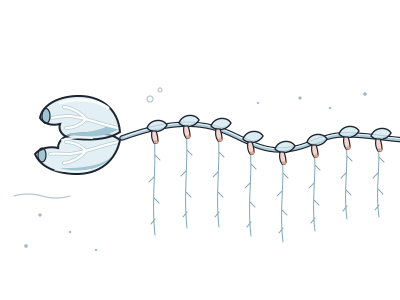
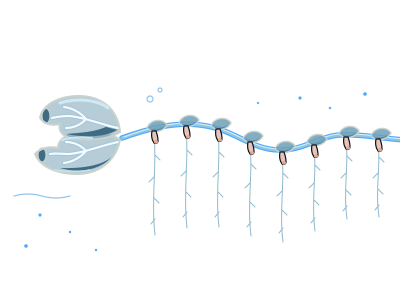
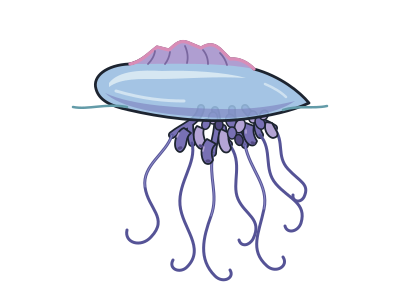
- Portuguese man o' warNot one jellyfish but a floating colony of specialised individuals working as one.
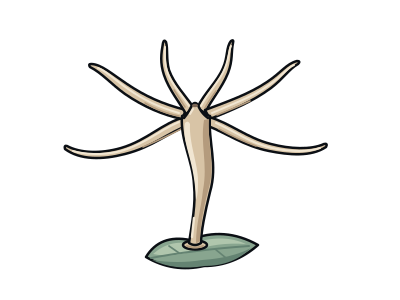
- Freshwater hydraA tiny freshwater polyp that can regrow its whole body from a small piece and barely seems to age.

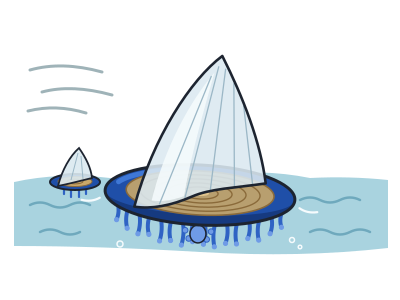
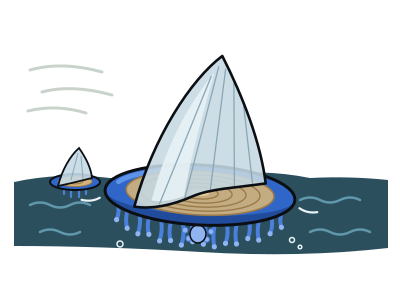
- By-the-wind sailorA blue raft with a stiff sail that drifts wherever the wind blows, sometimes washing ashore in millions.
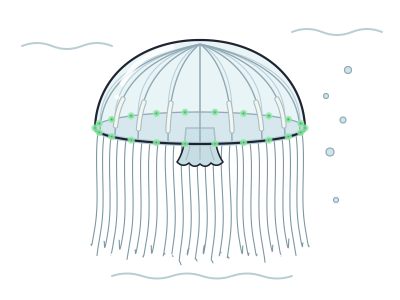
- Crystal jellyA clear jelly whose glowing green protein became a Nobel-winning tool for lighting up cells.
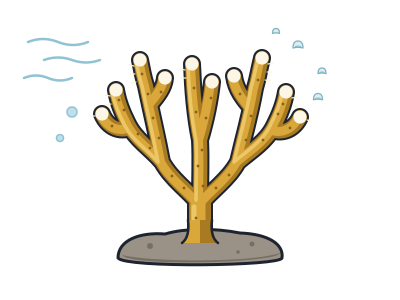
- Fire coralLooks like a coral and builds reefs, but is really a hydrozoan cousin of the man o' war.
- Giant siphonophoreA see-through string of linked individuals that can stretch as long as a blue whale.