A species
Arabica coffee
Coffea arabica
A shrub that guards itself with caffeine and uses a tiny dose to help bees remember it.
You and the arabica coffee meet in the Eukaryotes branch, shown at about 1.8 billion years ago (on 28 July, in a calendar from life's shared ancestor to today).
The chemical that wakes people up in the morning is really a plant's defence. Caffeine tastes bitter to many insects. In one experiment, caterpillars given food mixed with ground coffee beans or tea leaves ate less, became jittery and grew poorly. Larger doses killed them within a day.
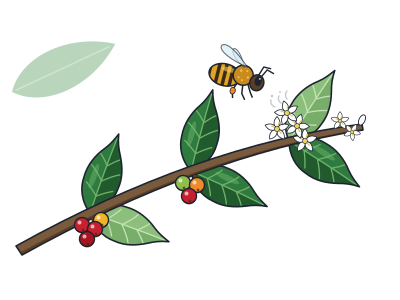
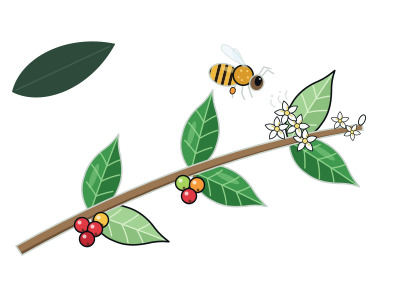
Coffee flowers use caffeine in a gentler way too. Their nectar holds only a tiny amount, too little for bees to taste. In a 2013 study, honeybees given sugar water with caffeine were about three times as likely to remember a flower's scent a day later. The caffeine acts on brain cells that help bees learn smells. A bee that remembers a flower may keep coming back to the same kind.
Look nearby on the tree and you will find the tea plant, which also makes caffeine. Both are flowering plants on the same big branch, but they did not get caffeine from a shared ancestor. Their caffeine-making genes evolved separately, so plants came up with caffeine more than once.
Arabica is itself a mix. It formed when robusta coffee and another wild coffee species crossed. It kept both parents' chromosomes, so it has 44, while each parent has 22.
The world's favourite cup
Arabica makes up about 60% of all the coffee grown in the world.
Does its own pollinating
Arabica mostly pollinates itself. Robusta, one of its parent species, cannot, and needs pollen from another plant.
A memory that lasts
Three days after learning a scent, bees that had caffeine were still about twice as likely to remember it as bees that had plain sugar.