A species
Coast redwood
Sequoia sempervirens
The tallest living tree on Earth, watered by sea fog
You and the coast redwood meet in the Eukaryotes branch, shown at about 1.8 billion years ago (on 28 July, in a calendar from life's shared ancestor to today).
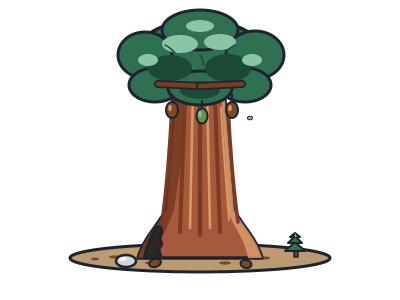
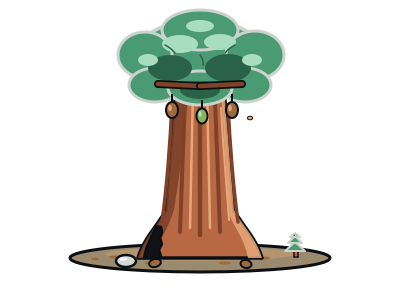
The tallest known living tree on Earth is a coast redwood. It is nicknamed Hyperion, grows in California and stands about 116 metres tall. That is taller than a 35-storey building. If you could lay it down, it would be longer than a typical football pitch. Coast redwoods often reach 600 years old, and some live for about 2,000 years.
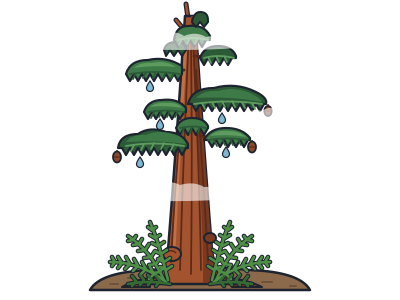
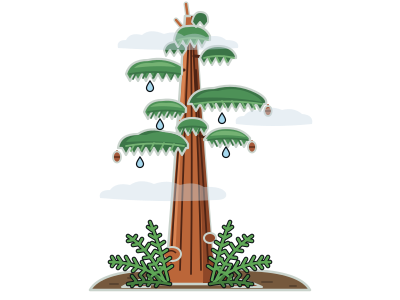
These trees grow wild only in a narrow strip along the Pacific coast. There, damp fog rolls in from the sea on many summer days. Fog gathers on the needles, turns into droplets and drips down to the soil and roots below. In summer, fog can provide about 40% of the water a coast redwood takes in. For a tree this tall, lifting water to the top is hard work, so that extra water really matters.
The coast redwood's closest living relatives are the other two redwoods, and each one is surprising in its own way. The giant sequoia, from California's Sierra Nevada mountains, is the biggest tree by volume, but it rarely grows taller than about 98 metres. The dawn redwood from central China was known only from fossils. Scientists thought it was extinct until living trees were found in the 1940s. Unlike its evergreen relatives, it drops its needles every autumn after they turn copper-orange.
Shallow roots
For such a tall tree, a coast redwood has surprisingly shallow roots, only about 3–4 metres deep. They spread 20–27 metres sideways. Because there is no deep central root, being blown over by wind is the most common cause of death for old trees, apart from logging.
Fairy rings
A cut or fallen coast redwood often sprouts again. It can send up a ring of new trunks around the old stump, known as a 'fairy ring'. Giant sequoias do not usually do this.
Six sets of chromosomes
People and most conifers have two sets of chromosomes (bundles of DNA). The coast redwood has six. It is the only conifer known to have six sets naturally.