A species
Hourglass trapdoor spider
Cyclocosmia truncata
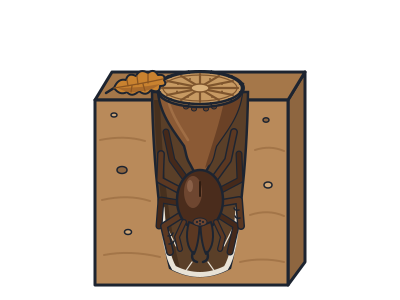
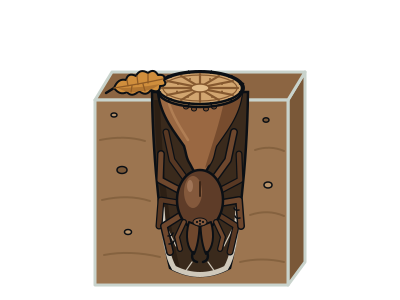
A spider that shuts its burrow with its own back end, like a living manhole cover.
You and the hourglass trapdoor spider meet in the Two-sided animals branch, shown at about 580 million years ago (on 11 November, in a calendar from life's shared ancestor to today).
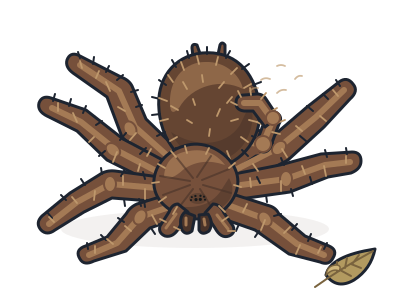
When most spiders sense danger, they run or hide. This one becomes a door. Its body ends suddenly in a hard, flat, round disc with ribs and grooves that make it look like a stamped coin. When it is threatened, it goes head-first down its burrow. The burrow gets narrower towards the bottom, so the rim of the disc wedges in tightly. From above, you would see only the disc, like a living manhole cover.
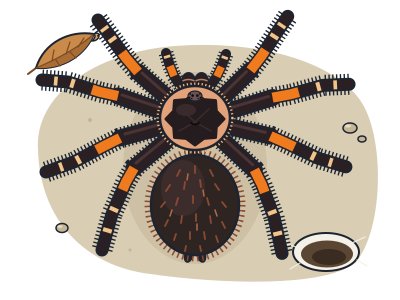
Its family links are surprising too. It belongs to the same branch of spiders as tarantulas such as the Goliath birdeater, and it is not closely related to ordinary web-building spiders. It is a stout digger with short, thick legs. Like tarantulas, it has fang-jaws that point downwards, and its jaws carry spines that help it dig.
It is small. A female is about 3 centimetres long, roughly the length of a standard paperclip, and males are smaller. It lives only in the south-eastern United States, mainly in Tennessee, northern Alabama and north-western Georgia. It digs its burrows into damp, shady slopes such as ravine walls and stream banks in hilly woods.
It does not spin a web to catch food. Instead, it waits at the entrance of its burrow and ambushes passing insects such as crickets and grasshoppers.
Relatives across an ocean
Its genus has about 13 species. A few live in the USA and Mexico, and the rest live in Asia, in China, Vietnam, Thailand and Laos, on the far side of the Pacific.
Not a beach killer
Viral social-media posts have used photos of these spiders to warn about a deadly 'beach spider' whose bite supposedly kills in minutes. In fact, these spiders live in burrows, not on beaches, and they are not deadly to people.
Plenty of nicknames
Because the disc looks so odd, people have nicknamed these spiders 'button spider', 'Oreo spider' and 'Aztec coin spider'.