A species
Toga bacterium
Thermotoga maritima
A heat-loving bacterium in a baggy robe, with a surprising patchwork of genes.
You and the toga bacterium meet in the All life branch, shown at about 4.2 billion years ago (on 1 January, in a calendar from life's shared ancestor to today).
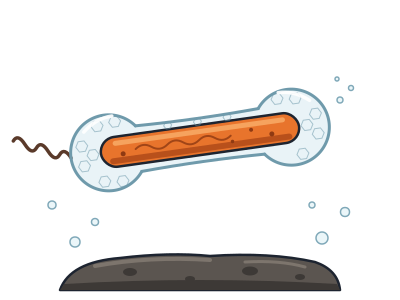
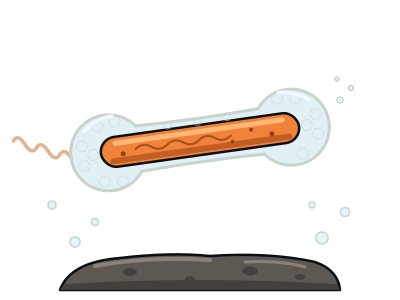
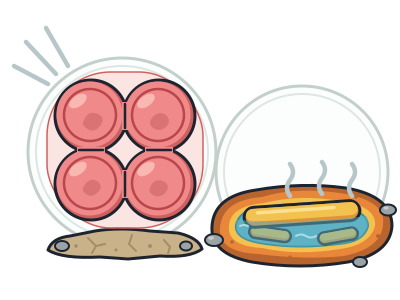
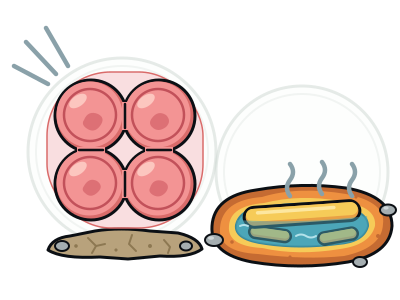
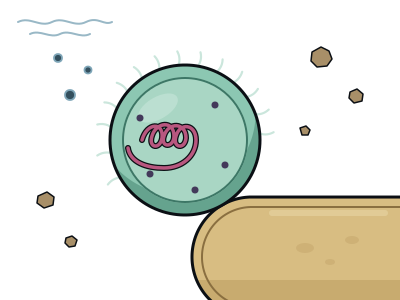
Picture a tiny rod wrapped in a baggy robe. This bacterium's loose outer layer reminded scientists of a toga, the robe worn in ancient Rome, so they named it after one. The 'toga' is really its outer membrane. It fits closely along the sides of the cell but puffs out like a balloon past each end.
It lives in sea-floor mud heated by volcanoes, where there is no oxygen. It grows best at about 80 °C, hotter than a cup of tea that has cooled enough to drink. It feeds by breaking down sugars, even tough plant material, and gives off hydrogen gas.
Its biggest surprise is in its genes. When scientists first read all of its DNA in 1999, about a quarter of its genes looked most like genes from archaea, a separate branch of single-celled life. Some of these genes sit together in blocks, often in the same order as in archaea. It looks as if whole chunks of DNA were passed across. Other genes look like those of quite different bacteria. It is a patchwork of genes from different sources, and that makes its place in the family tree hard to pin down.
Found on a volcanic island
Scientists first described it in 1986. It came from hot, volcano-heated sea-floor sediment at Porto di Levante on Vulcano Island, Italy.
Breaks a heat-lover rule
Many heat-loving microbes have DNA rich in the letters G and C, which hold together more strongly. This one has only about 46% G and C, so that kind of DNA is not essential for living in heat.
A small instruction book
Its DNA is one loop of about 1.86 million letters, holding nearly 1,900 predicted genes. When it was first read, scientists did not know what almost half of those genes did.
Next to it on the tree
- CyanobacteriaPond scum that filled the air with oxygen and later moved into plant cells as chloroplasts.
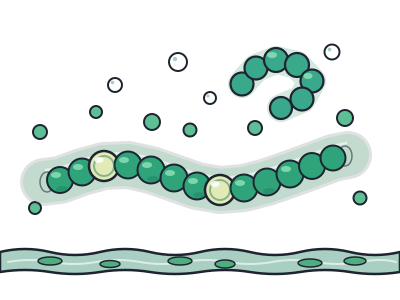
- Spore-formers and yogurt bacteriaTough bacteria that brew yogurt, live on your skin, and can sleep for years as armoured spores.
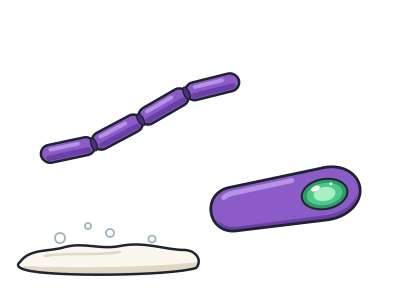

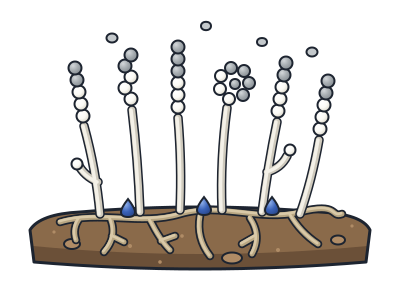
- Soil antibiotic-makersBranching soil bacteria that give rain its earthy smell and gave us most of our antibiotics.
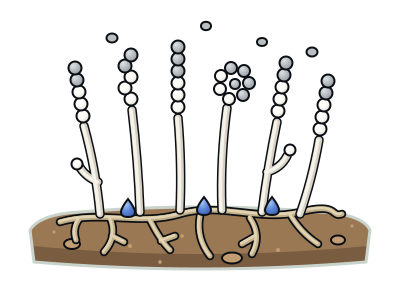
- Extreme survivorsA small branch of champions: one survives huge radiation doses, its cousin loves hot springs.
- Tiny-genome bacteriumPart of a hidden branch of ultra-small bacteria found only by reading DNA, perhaps a quarter of all bacterial kinds.
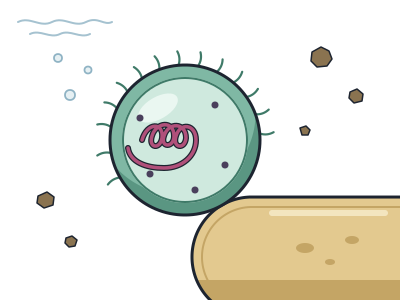
- Hot-spring filamentOrange-green threads that glide through hot-spring mats, using sunlight without ever making oxygen.