An extinct species
Pyramid coin-shell †
Nummulites gizehensis
The coin-shaped sea shells packed into the Giza pyramids
Lived about 48–40 million years ago.
You and the pyramid coin-shell meet in the Eukaryotes branch, shown at about 1.8 billion years ago (on 28 July, in a calendar from life's shared ancestor to today).
The great pyramids at Giza are built partly from the shells of countless tiny sea creatures. Look closely at the limestone blocks and you can see flat, coin-shaped fossils packed together. Many of them are pyramid coin-shells. The species is named after the Giza plateau, and it is one of the most common kinds in the pyramid stone.
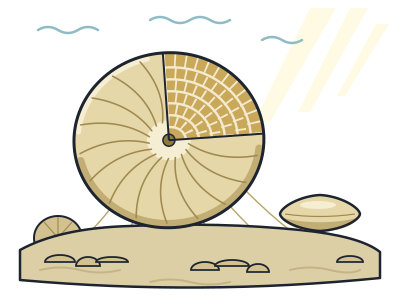
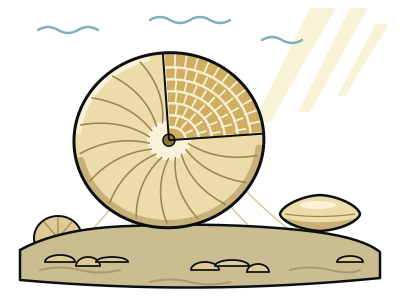
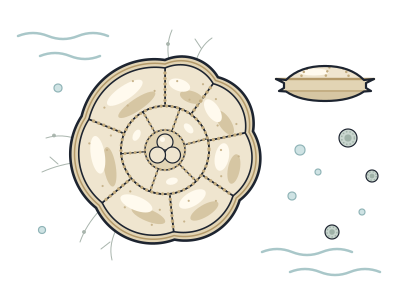
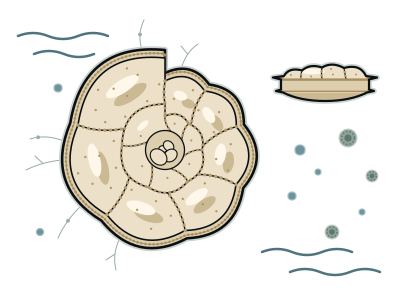
Each little coin was once a single living cell. It belonged to the forams, which are single-celled creatures a bit like amoebae that build hard shells. On the tree of life, forams sit on the same big branch as kelp and diatoms. Split one of these fossils open and you find a flat spiral, like a watch spring, divided into many small chambers.
It lived about 48 to 40 million years ago on the floor of a warm, shallow sea that covered much of Egypt. Only the shells survive as fossils. Scientists think tiny algae lived inside the cell and used sunlight to help it build its shell faster. Over millions of years, the shells piled up and hardened into limestone. Much later, the pyramid builders cut that limestone into blocks.
Mistaken for lunch
The ancient Greek geographer Strabo said the pyramid fossils were 'like lentils in both form and size'. He repeated a local story that they were the workers' leftover food, turned to stone.
Giant single cells
It and some of its relatives were among the biggest single-celled living things ever. The largest grew to about 10 cm across, roughly the size of a large biscuit.
Rock clocks
These shells were very common, easy to recognise and lived only at certain times. That makes them useful to geologists for working out how old a rock is.
Next to it on the tree
- FusulinidsRice-grain shells that crowded warm seas for 80 million years, then died in the Great Dying.
- Living beach ballA single cell up to 20 centimetres across, living on the deep sea floor.
- GlobotruncanaKeeled, wheel-shaped plankton shells of the dinosaur age, wiped out by the asteroid impact.
- GlobigerinaA floating foram whose shells carpet the ocean floor and record past climates.
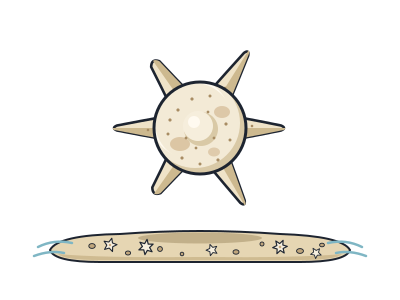
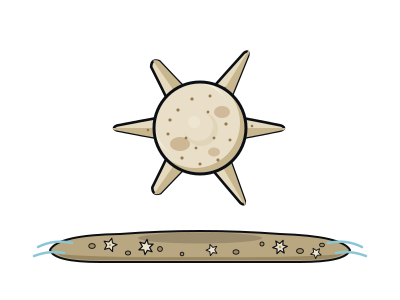
- Star sandThe tiny star-shaped grains on some Okinawan beaches are the shells of this foram.