A species
Yellow morel
Morchella esculenta
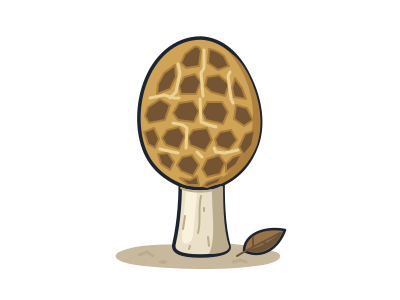
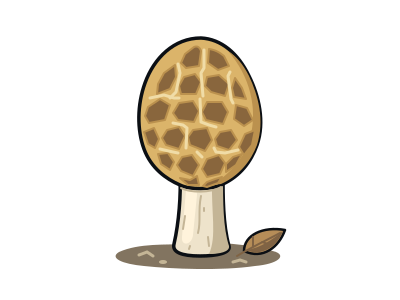
A honeycomb-capped spring mushroom on the sac-fungus branch.
You and the yellow morel meet in the Fungi and animals branch, shown at about 1.3 billion years ago (on 10 September, in a calendar from life's shared ancestor to today).
With its honeycomb cap, the yellow morel is a spring prize sought by foragers. Yet it belongs to the sac fungi, a different branch from typical gilled mushrooms. The difference is microscopic: sac fungi make their reproductive spores inside tiny sacs, while typical gilled mushrooms make them on tiny club-shaped structures. “Toadstool” is an everyday name, not a scientific group.
Its cream to yellowish-tan cap has deep, uneven pits separated by raised ridges. Think of many tiny cup-like surfaces gathered together on a stalk, rather than a neat honeycomb of matching hexagons. Both the cap and the pale stem are hollow.
The mushroom you see is only the spore-making part of the fungus. Much of the organism is an unseen network of microscopic threads. This morel can break down dead material, helping return nutrients to the soil. Its striking appearance is not a safe guide to eating: poisonous false morels exist.
Eight in a sac
Each cylindrical spore sac typically contains eight spores.
Room for insects
Insects can inhabit the hollow stem and cavities inside the cap.
An early family mix-up
Linnaeus described this morel in 1753, but placed it with stinkhorns, which belong to a different major fungal branch.