A species
Collared earthstar
Geastrum triplex
A fungus star with a ball in the middle that puffs out spores when rain hits it.
You and the collared earthstar meet in the Fungi and animals branch, shown at about 1.3 billion years ago (on 10 September, in a calendar from life's shared ancestor to today).
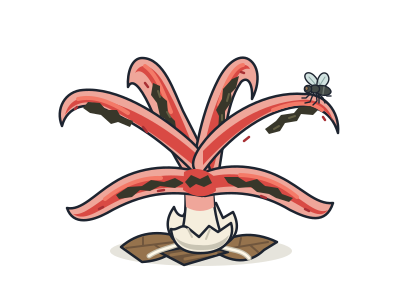
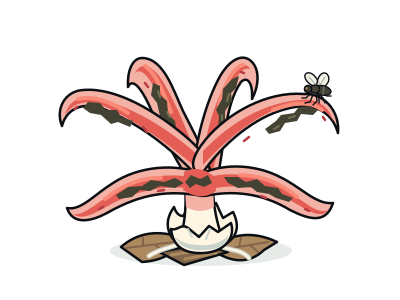
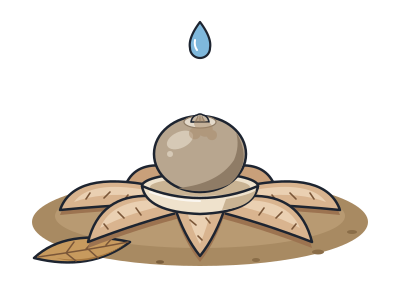
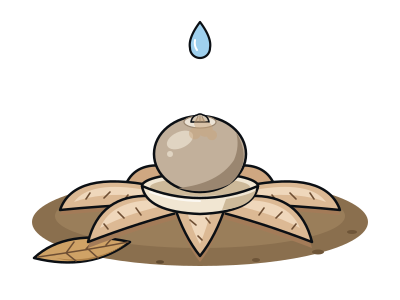
Picture a small brown ball sitting in the middle of a star on the forest floor. When the collared earthstar is ready, its tough outer skin splits into about four to eight pointed arms. These fold back until they touch the ground. When a raindrop lands on the thin, papery ball, it pushes out a puff of brown spore dust through a little hole on top, a bit like squeezing a tiny bellows. Wind blowing across the hole can carry spores away too.
As the arms bend back, they often crack around the bottom of the ball. That leaves the ball sitting in a pale saucer, or collar, which gives this earthstar its name. The open star is usually about 5 to 10 centimetres across.
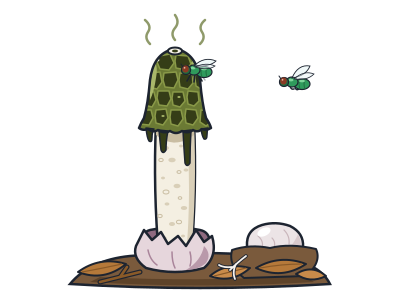
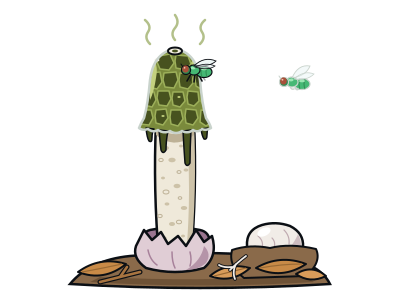
It looks a lot like a puffball. But DNA studies place earthstars in the same wider group as the smelly stinkhorns beside it on the tree, along with coral fungi. And it is not a plant at all. The star is only the spore-making part of a hidden web of fungus threads that feeds on rotting leaves.
It grows in leaf litter, near rotting stumps and in gardens in many parts of the world, including Australia, Europe, Africa and the Americas.
No weather dance
Some earthstars open and close their arms as the air gets damp or dry. This one doesn't. Once its arms open, they stay that way.
Long-lasting stars
Old, dried-up collared earthstars can stay in place for months. Some survive the winter and are still there the following year.
Spiky specks
Each spore is round and covered in tiny spines. It is only about 4 thousandths of a millimetre wide, far too small to see on its own.