A species
Atlantic blue crab
Callinectes sapidus
A crab that swims with paddle-shaped back legs and waves bright blue claws
You and the atlantic blue crab meet in the Two-sided animals branch, shown at about 580 million years ago (on 11 November, in a calendar from life's shared ancestor to today).
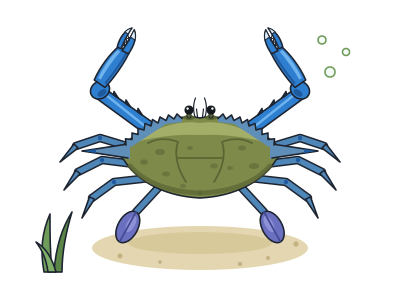
This crab can swim. Its last pair of legs is flattened into broad paddles, which it uses like oars to move sideways through the water. Its claws are a bright sky-blue. It shares the true crab branch of the tree with the fiddler crab and the Christmas Island red crab, but those crabs do not have swimming paddles.
Despite its name, it is not blue all over. The top of its shell is usually olive-green or mottled brown. The shell is about twice as wide as it is long, with a long, sharp spine on each side, so it looks pointed at both ends. The biggest reach about 23 cm across, nearly as wide as a dinner plate. Grown-up females have red tips on their claws.
Blue crabs live along the western Atlantic coast, from Canada to Argentina. Most live in estuaries, where rivers meet the sea, in water that ranges from nearly fresh to fully salty. They eat almost anything, including clams, oysters, snails, fish, plants, dead animals and even smaller blue crabs. Like all crabs, they have to moult, shedding their hard shell, so they can grow.
Once in a lifetime
A female mates only once, just after her last moult while her shell is still soft. Beforehand, the male carries her underneath him in a protective 'cradle' hold.
Millions of eggs
A female carries a spongy mass of eggs under her body. One batch can hold about 750,000 to more than 3 million eggs.
Drifting babies
The tiny larvae drift in salty coastal water for about four to eight weeks. They usually change shape through seven early stages and then one last stage. Then they return to river mouths and settle down as baby crabs.