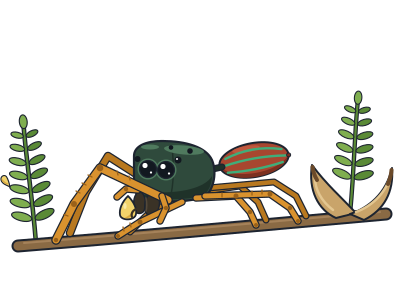
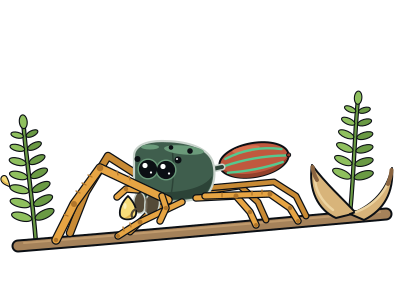
A species
Vegetarian jumping spider
Bagheera kiplingi
The only spider known to live mostly on plant food
You and the vegetarian jumping spider meet in the Two-sided animals branch, shown at about 580 million years ago (on 11 November, in a calendar from life's shared ancestor to today).
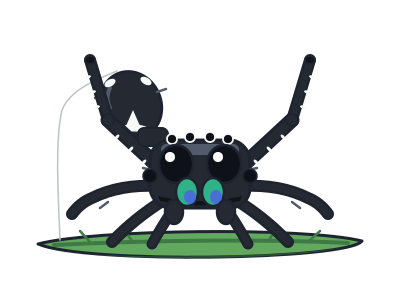
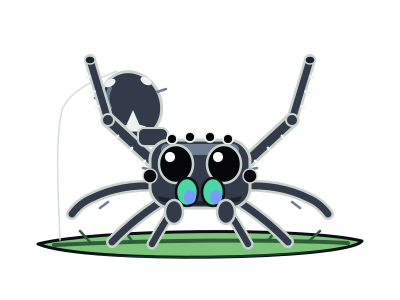
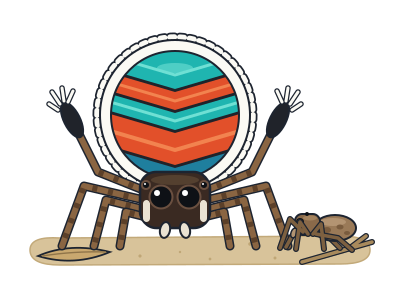
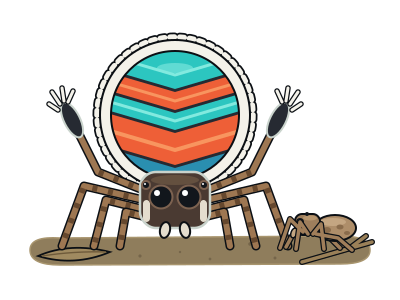
Spiders are famous meat-eaters, but this tiny jumping spider breaks the rule. It is the only spider known to live mainly on plants. Its relatives on the tree, such as the peacock spider and the regal jumping spider, are hunters. Many jumping spiders take an occasional sip of nectar, but none is known to rely on plants the way this one does.
Its main food is Beltian bodies. These are small nubs, rich in protein and fat, that grow on the leaf tips of certain acacia shrubs in Central America. The shrubs make them to 'pay' the bodyguard ants that live in their hollow thorns. The spider steals the ants' food. In Mexico, these nubs made up about nine-tenths of what it ate.
Stealing from guard ants is risky. The spider builds its nest at the tips of the oldest leaves, where ants rarely patrol. If it is cornered, it leaps away or drops on a silk line and hangs in mid-air until the danger passes.
It is not a strict vegetarian. It also drinks nectar and sometimes eats ant larvae, flies and, now and then, other spiders. Until scientists described its plant diet in 2009, spider textbooks said no plant-eating spider existed.
Named after a panther
Its name comes from Bagheera, the black panther in Rudyard Kipling's The Jungle Book, and from Kipling himself. The male was described in 1896, but the female was not described until 1996, a century later.
Chemical proof
Tests on the spiders' bodies backed up the plant diet. Their chemical 'signature' matched the Beltian bodies, and they had less of a heavy form of nitrogen than other jumping spiders.
Sharing the nursery
Females guard their eggs and newly hatched young, and several females may share one breeding nest. Living side by side like this is unusual for jumping spiders, which usually live alone.