A species
Peacock spider
Maratus volans
A spider the size of a rice grain that dances with a rainbow fan
You and the peacock spider meet in the Two-sided animals branch, shown at about 580 million years ago (on 11 November, in a calendar from life's shared ancestor to today).
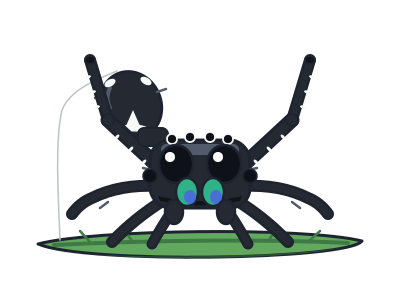
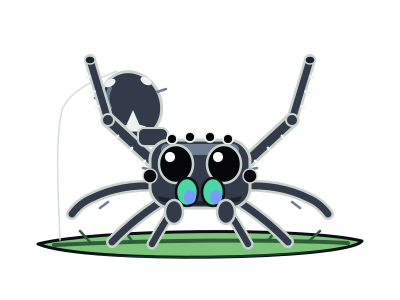
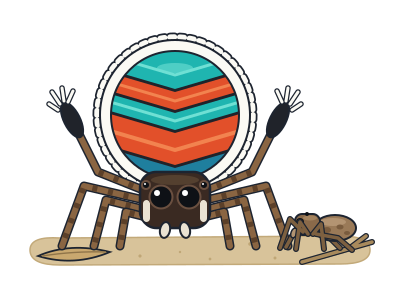
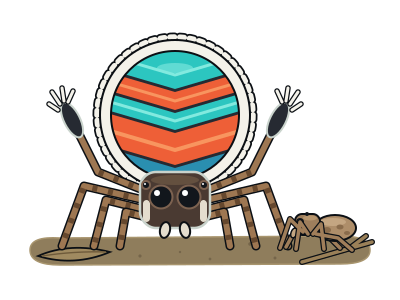
A male peacock spider is only about the size of a grain of rice, but he puts on a dazzling dance. When he meets a female, he unfolds two flaps on his rear body into a round fan of orange-red and shimmering blue, edged with white hairs. He holds it up like a peacock's tail and swings it from side to side. At the same time, he lifts his third pair of legs, which have white tips, and waves them in time with the fan.
He also sends vibrations through the ground. Scientists gave them names such as 'rumble-rumps' and 'grind-revs'. Females are very choosy. In one study, they accepted only about one male in four. A female who is not impressed may attack him, so he must be ready to jump away.
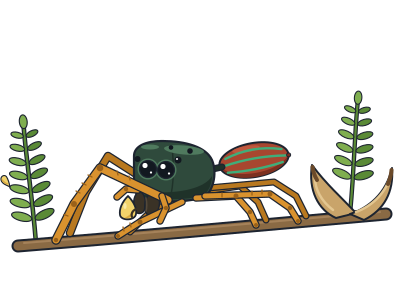
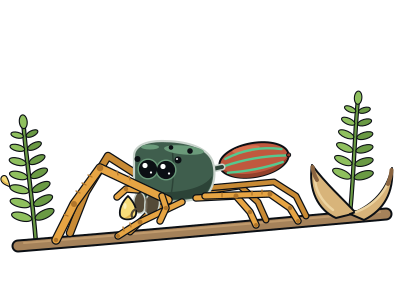
Under all that colour, it is a jumping spider, a relative of the regal jumping spider and the vegetarian jumping spider. Like them, it does not catch prey in a web. It has excellent eyesight and stalks and pounces on its prey. Females have no fan. They are mostly brown and are thought to blend in with the marks on dry twigs. The species lives only in Australia, on the ground in leaf litter, grasslands and sand dunes.
A misleading name
Its scientific name means 'flying' in Latin. It was named in 1874 after mistaken reports that it used its flaps to glide. It cannot fly or glide.
A long performance
In a lab study, a full courtship lasted between about 6 and 51 minutes, or about 24 minutes on average.
The final move
Just before he tries to mate, the male takes a 'glider pose'. He stretches his front legs forward and holds his third legs up in an upside-down V.