A species
Adder's-tongue fern
Ophioglossum reticulatum
A tiny fern with one leaf, one spike and a record number of chromosomes for a plant.
You and the adder's-tongue fern meet in the Eukaryotes branch, shown at about 1.8 billion years ago (on 28 July, in a calendar from life's shared ancestor to today).
This little fern grows just one leaf and one spore spike, and it is easy to miss among the grass. Yet some of these plants have more chromosomes in each cell than any other known plant: more than 1,000, and perhaps about 1,440. You have 46. Chromosomes are the bundles that carry a living thing's DNA. The number varies a lot from one population to another.
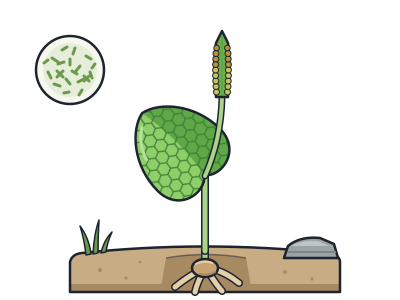
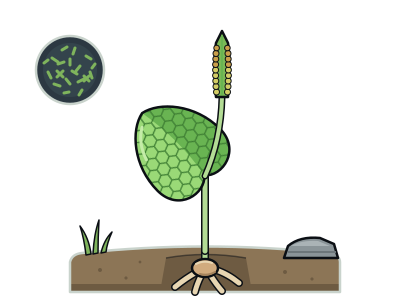
It does not look like a typical fern. There are no feathery fronds. A single pale stalk splits in two. One part is a flat green blade, often heart-shaped or round, with a fine net of veins like lace. The other part is a slim upright spike. People thought the spike looked like a snake's tongue, which is how the plant got its name.
Its closest relatives are just as surprising. DNA studies show that whisk ferns, which have no true roots or leaves, are the sister group of the adder's-tongue family. One member of the whisk-fern family, a fork fern only about 15 cm long, has the most DNA ever measured in any living thing. So two small, simple-looking relatives hold two different records: one for the most chromosomes, the other for the most DNA.
It grows in warm parts of the world, from Africa and Asia to tropical America and tropical and subtropical Australia. It mostly shows above ground in the rainy season.
On the menu
In Zanzibar people eat the leaves as a salad or a cooked vegetable. In Indonesia cooks only blanch them quickly, because boiling them too long turns them to slime.
Termite-mound fern
In Africa it can grow on termite mounds and roadsides, and from the seaside up to about 2,500 metres high in the mountains.
Spreading colonies
It can send out runners that start new plants, so it sometimes forms quite large patches.