A species
Velvet horn
Codium fragile
A spongy green seaweed whose sunlight-catching parts get stolen by sea slugs and keep working.
You and the velvet horn meet in the Eukaryotes branch, shown at about 1.8 billion years ago (on 28 July, in a calendar from life's shared ancestor to today).
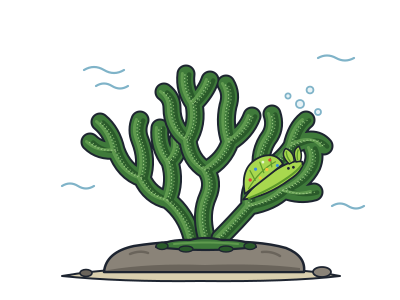
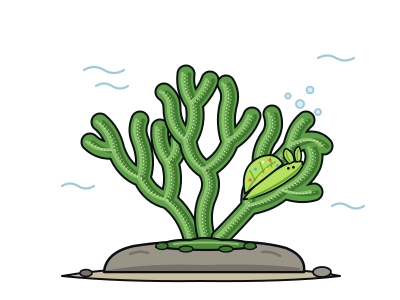
This soft green seaweed has an unusual fan club. A small sea slug pierces the seaweed, sucks out what is inside and keeps the seaweed's chloroplasts whole. Chloroplasts are the little green parts that turn sunlight into food. Inside the slug, these stolen chloroplasts keep working and pass it food. One study estimated that in bright light they may supply about half of the slug's growth. Taking chloroplasts like this is called kleptoplasty.
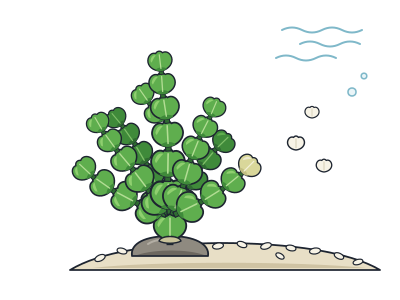
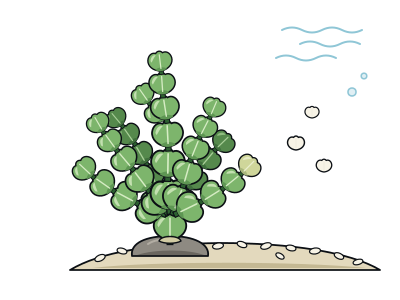
The seaweed itself is just as odd. Its round, pencil-thick branches fork again and again into Y shapes and have a soft, velvety surface. Yet the whole bushy body is basically one giant cell with many nuclei. Its relatives among the bubble and grape seaweeds, including sea grapes and cactus seaweed, can be built this way too. In some sea grape seaweeds, one cell can be several metres across.
It is thought to come from the north-west Pacific around Japan. It has spread around the world on ship hulls, as drifting broken pieces and with shellfish moved from place to place. In some places it can take over from eelgrass and kelp. Another name for it is oyster thief. It can grow on oysters and other shellfish. When it fills with gas, it may float away and carry the shellfish with it.
Tough traveller
Pieces of it have survived up to 90 days out of water in damp air.
No partner needed
Most invasive populations reproduce without mating. Their spores grow on their own, and broken-off pieces can grow into new seaweeds.
Arrival in America
It was first recorded as a newcomer in North America in 1957, at Long Island, New York.