A species
Cactus seaweed
Halimeda opuntia
A green seaweed whose chalky coins turn into white beach sand
You and the cactus seaweed meet in the Eukaryotes branch, shown at about 1.8 billion years ago (on 28 July, in a calendar from life's shared ancestor to today).
When cactus seaweed dies, its little green coins fall apart, lose their colour and turn white. These chalky flakes become part of the pale sand on tropical beaches. Together with its close relatives, this kind of seaweed can make up as much as half of the beach sand on some Caribbean islands.
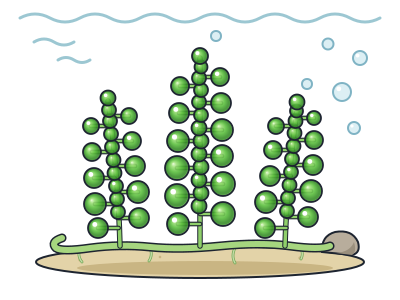
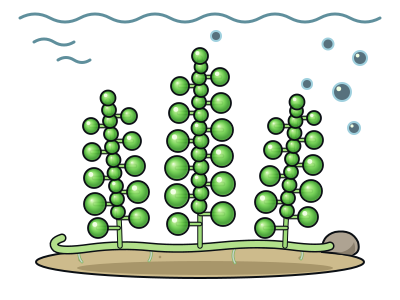
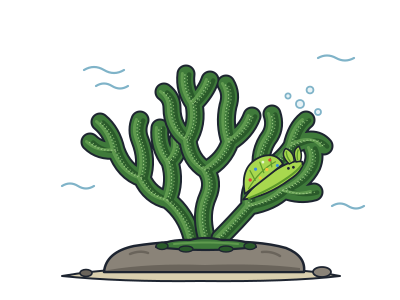
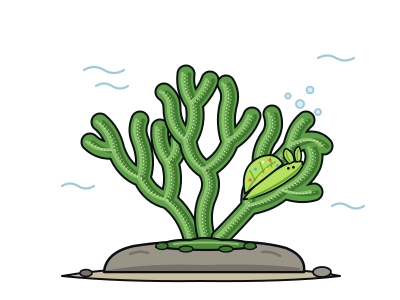
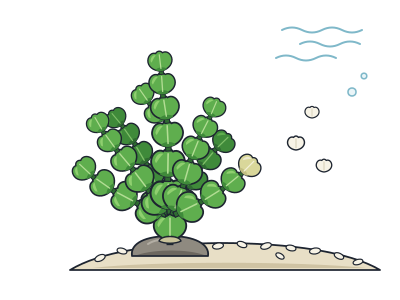
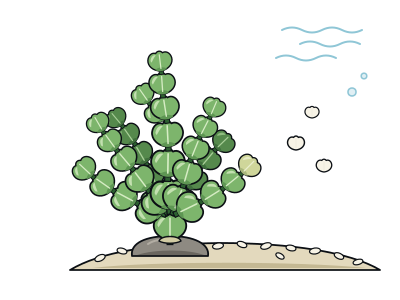
A living plant is a low, bushy clump up to about 25 centimetres tall, a bit like a tiny prickly-pear cactus. Its branches are chains of stiff, flat segments, each about the size of a fingernail, linked by bendy joints. Each segment is mostly chalk, the same mineral as in many seashells.
Despite its name and its hard body, it is neither a cactus nor a coral. It is a green seaweed, part of the same big branch of life as trees and grass. On the tree it sits beside sea grapes and velvet horn, two other green seaweeds. Surprisingly, its whole body is one giant branching cell, with no walls dividing it up.
It lives in warm seas around the world. It tucks itself into cracks and gaps between corals or grows on sandy bottoms, from the low-tide line down to about 50 metres.
A fast farewell
Seaweeds of its kind can reproduce in about 36 hours. Overnight, tiny structures form on the edges of the segments, release their sex cells the next morning, and then the whole plant dies.
Armour made at night
During the day it lays down fine, needle-like chalk crystals. At night these partly dissolve and fuse into a dense armour that makes the plant strong and hard to eat.
Not everyone is put off
Its chalky body makes it a crunchy, unappealing meal for most plant-eating animals, but parrotfishes still graze on it.