A species
Sea grapes
Caulerpa lentillifera
Tiny green beads that pop in your mouth, and the whole seaweed is one giant cell.
You and the sea grapes meet in the Eukaryotes branch, shown at about 1.8 billion years ago (on 28 July, in a calendar from life's shared ancestor to today).
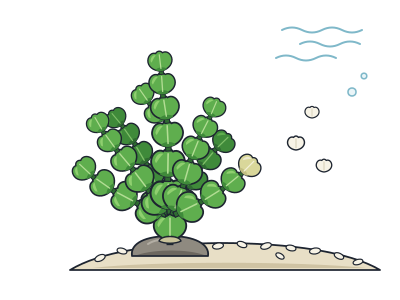
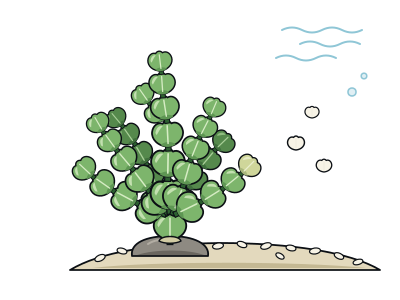
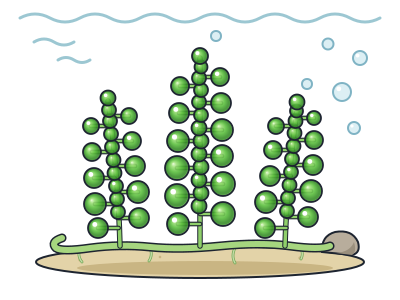
Picture a strand of tiny green beads that pop when you bite them. In Japan and the Philippines, people eat this seaweed raw. In English it is often called "green caviar". Each bead bursts with a savoury taste. In Okinawa it is called umi-budō, meaning "sea grapes", and is dipped in ponzu sauce or put in sushi. In the Philippines it is called latô and is tossed into a salad with tomatoes and shallots.
Here is the surprise. The whole seaweed, with its runners, stalks and hundreds of beads, is just one giant cell. It has many nuclei, and its living insides flow around inside a single cell wall with no inner walls dividing them up. It can grow to about 30 centimetres long, roughly the length of a school ruler.
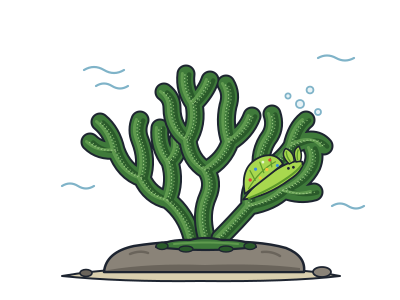
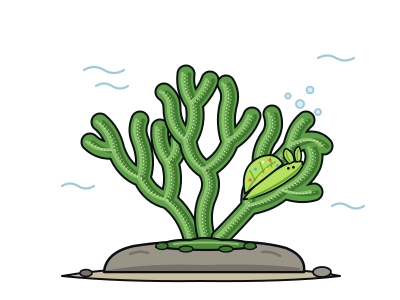
On the tree, its closer relative here is cactus seaweed, which is built the same way. In cactus seaweed and its close relatives, a whole meadow on the seabed may be one single-celled individual, linked by threads running through the seabed. Velvet horn is a more distant relative in the same group of tube-shaped green seaweeds.
In the wild, sea grapes grow on sandy or muddy reef flats in warm, calm, salty tropical seas. Each "grape" is only about 1 to 3 millimetres across, somewhere between a pinhead and a peppercorn.
Farmed by accident
Sea grape farming in the Philippines began by chance in the 1950s, when the seaweed got into fish ponds in Cebu.
Grown from pieces
Commercial farming in Okinawa began in 1986. On farms, new sea grapes grow mainly from broken-off pieces of the seaweed.
One name, two seaweeds
Sea grapes are one of about 100 kinds of seaweed in the same close-knit group, and two different kinds from that group are farmed and sold as "sea grapes".