A species
Tiger lily
Lilium lancifolium
An orange lily that grows copies of itself from black beads along its stem
You and the tiger lily meet in the Eukaryotes branch, shown at about 1.8 billion years ago (on 28 July, in a calendar from life's shared ancestor to today).
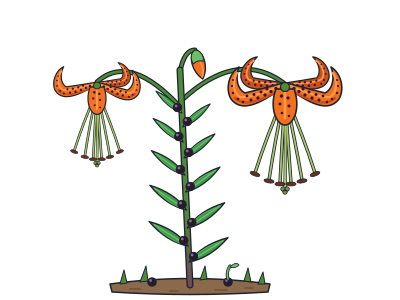
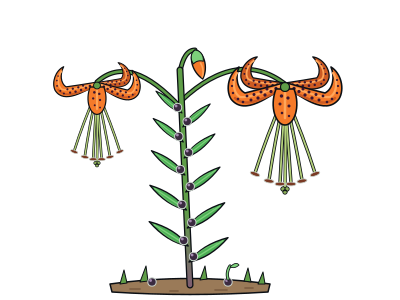
A tiger lily has bright orange petals dotted with dark spots. They curl so far back that the tips nearly meet behind the flower. Now look further down the stem. Where each leaf joins it, there is a small shiny black ball, like a bead. These are bulbils, which are tiny bulbs. They drop to the ground and grow into new lilies that are genetic copies of the parent. Few other lilies do this.
The bulbils matter because the common garden tiger lily has three sets of chromosomes instead of the usual two. Because of this, it makes no seed, or almost none, so the bulbils do the job instead. Wild plants in China and Korea that have two sets can still make seed. Gardeners call the tiger lily weedy because the bulbils help it spread so easily.
The tiger lily comes from East Asia and probably started in China. In the wild it grows in damp meadows, on sunny woodland edges and on rocky slopes beside streams. People in Asia grow its bulbs and gather them as food. Stems are usually about 80 to 150 centimetres tall. Some reach about 2 metres, which is taller than most adults. On the tree it sits in the lily group, beside the garden tulip and the canopy plant.
Dangerous to cats
Every part of a tiger lily is poisonous to cats, even the pollen and the water in a vase. A small amount can make a cat's kidneys suddenly stop working.
No perfume
For such a bright flower, the tiger lily is surprisingly quiet to the nose: its flowers have no scent at all.
Parent of garden lilies
Wild tiger lilies that can make seed were important parents of the colourful Asiatic hybrid lilies sold in garden centres today.