A species
Starlet sea anemone
Nematostella vectensis
A see-through mud-dweller whose genes look surprisingly like ours
You and the starlet sea anemone meet in the Animals branch, shown at about 700 million years ago (on 1 November, in a calendar from life's shared ancestor to today).
This see-through sea anemone lives in muddy salt-marsh pools, and its young are only pinhead-sized. Even the adults are usually only about as long as your fingernail. Yet this tiny animal helps scientists with a big question: how are animal bodies built?
It is a relative of jellyfish and corals, and its body looks very simple, so you might guess its genes would be simple too. They are not. When scientists published its genome in 2007, they found it was organised more like ours than like a fruit fly's or a worm's. About two-thirds of the gene families in humans and sea anemones go back to an ancestor they share. Flies and worms have lost many of those old genes.
It can also rebuild its own body. If one is cut through the middle, the head half grows a new tail end and the tail half grows a new head. Many of the genes involved are found in humans too.
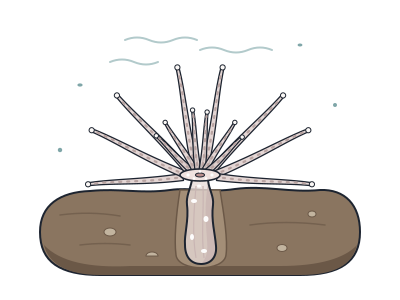
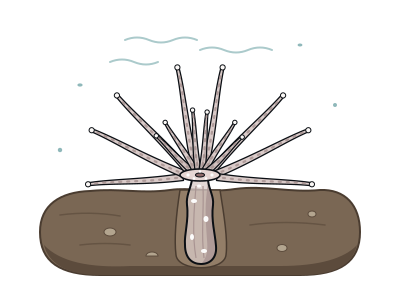
In the wild it stays buried in soft mud, and only its star-like crown of thin tentacles shows on the surface.
Named after an island
Its scientific name comes from 'Vectis', the old Latin name for the Isle of Wight. Scientists first described it in 1935 from brackish pools on that island.
Copes with ice and heat
It has been found in water from just below freezing to about 28 °C. It also copes with water that is much less salty or much saltier than the sea.
Protected by law
In the UK it is protected by law, and the IUCN Red List says it is Vulnerable, which means it could be at risk of dying out in the wild.