A species
Stalked jellyfish
Haliclystus auricula
A jellyfish that never swims, living stuck to seaweed like an upside-down flower.
You and the stalked jellyfish meet in the Animals branch, shown at about 700 million years ago (on 1 November, in a calendar from life's shared ancestor to today).
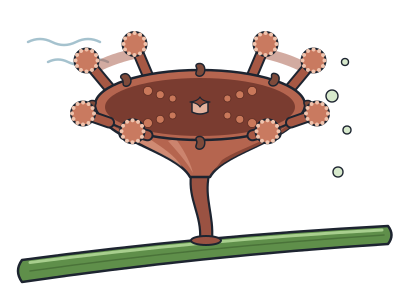
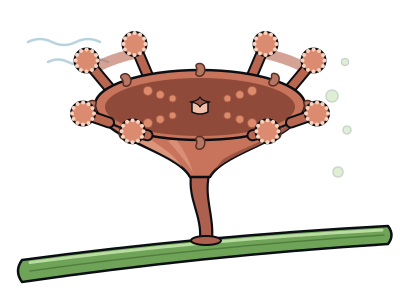
Picture a jellyfish that never swims. This one spends its adult life stuck to seaweed or seagrass by a thin stalk, like a tiny flower on a stem. Compared with other jellyfish it looks upside down. Its tentacles point upwards, and the stalk grows from the outer side of the bell.
Its relatives include true jellyfish and box jellyfish, such as the sea wasp, which swim through the sea. Most jellyfish switch between an attached polyp stage and a free-swimming stage. This animal skips the swimming part. Its young start as a small creeping larva that settles and becomes a tiny polyp. The top of the polyp then turns into the jellyfish-like body, and the bottom stays as the stalk.
It is only about 2 to 2.5 cm tall, about as tall as your thumb is wide. Eight short arms spread from its funnel-shaped body. Each arm ends in a pom-pom of up to about 100 tiny tentacles. It sits and waits, catching tiny crustaceans with stinging cells. To move, it sticks a sticky 'anchor' on its rim to the surface, lets go with its base and cartwheels to a new spot.
Named by the public
Its common name, 'Kaleidoscope jellyfish', was picked in a 2010 public competition. One runner-up name was 'Mermaid's trumpet jellyfish'.
A short life
Each animal is thought to live for only about one year. Numbers are highest from spring into late summer, then die off in autumn.
Hard to tell apart
It is easily mixed up with a much more common look-alike relative. In the UK, the true species has been confirmed at only one site, in Orkney.
Next to it on the tree
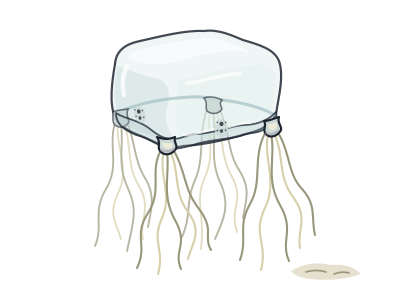
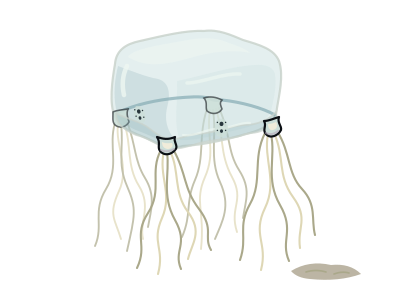
- Sea waspA box-shaped jellyfish with 24 eyes and one of the most dangerous stings in the sea.
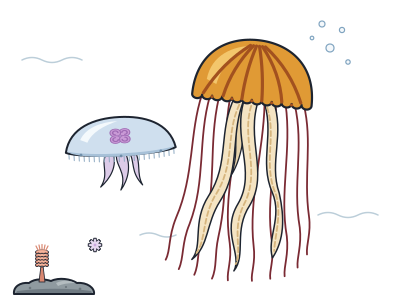
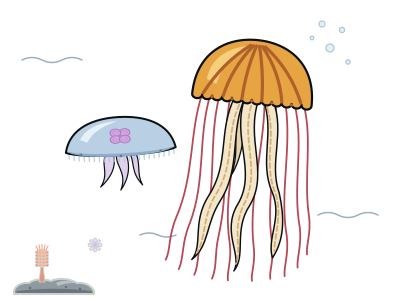
- True jellyfishThe classic jellyfish: a pulsing bell with trailing arms, grown from a polyp that buds off baby jellies.
- Hydroids and siphonophoresThe most varied cnidarians: tiny polyps, floating colonies and jellies that can glow.
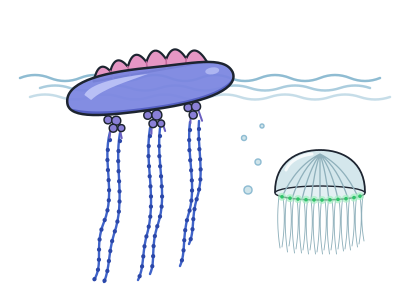
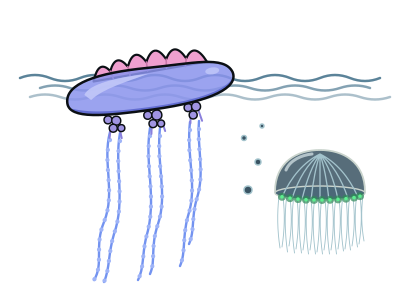
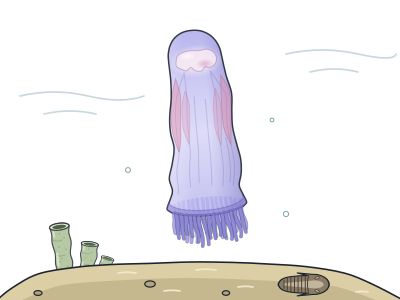
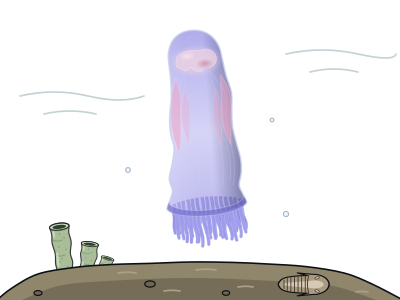
- BurgessomedusaThe oldest known swimming jellyfish, a bell-shaped fossil from the Burgess Shale with dozens of tentacles.