An extinct species
Burgessomedusa †
Burgessomedusa phasmiformis
The oldest known swimming jellyfish, a ghostly bell from an ancient sea
Lived about 507–505 million years ago.
You and the burgessomedusa meet in the Animals branch, shown at about 700 million years ago (on 1 November, in a calendar from life's shared ancestor to today).
Long before there were fish with jaws, this jellyfish was already pulsing through a shallow tropical sea. No older swimming jellyfish big enough to see without a microscope is known. Its fossils come from the Burgess Shale, high in the Rocky Mountains of British Columbia, Canada.
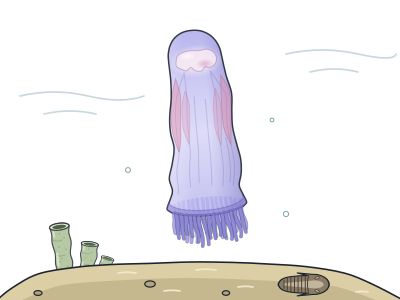
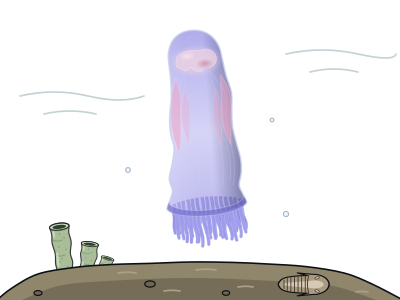
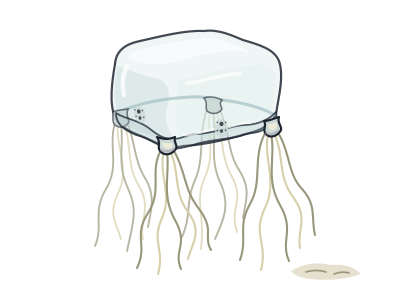
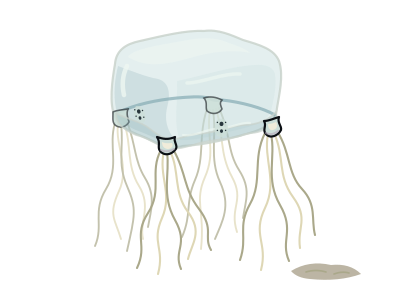
It belongs to the same big family as today's true jellyfish, stalked jellyfish and hydroids. Its tall, box-shaped bell looks a lot like those of modern box jellyfish, such as the sea wasp. Scientists think it was probably an early side branch near the box jellyfish line. It is not known to be the ancestor of any jellyfish living today.
The bell grew up to about 20 centimetres tall, roughly the length of a pencil. More than 90 short, finger-like tentacles hung from its rim. The fossils show a large stomach near the top and a thin tube hanging down from it. Four dark patches in the corners were probably its reproductive organs.
Jellyfish are about 95% water, so they almost never become fossils. In the Burgess Shale, though, fine mud saved almost 200 of these animals as thin, dark films.
A ghostly name
Its species name means 'ghost-shaped' because the fossil bells look like faint, phantom outlines in the rock.
Hidden in a museum
Most of the fossils were collected in the late 1980s and 1990s. They sat in museum collections until scientists finally described the species in 2023.
A catch inside the bell
One fossil has animals with jointed legs, including a trilobite, inside its bell. This suggests it could catch large, active prey, so big hunters like Anomalocaris were not the only predators in those seas.
Next to it on the tree
- Sea waspA box-shaped jellyfish with 24 eyes and one of the most dangerous stings in the sea.
- True jellyfishThe classic jellyfish: a pulsing bell with trailing arms, grown from a polyp that buds off baby jellies.
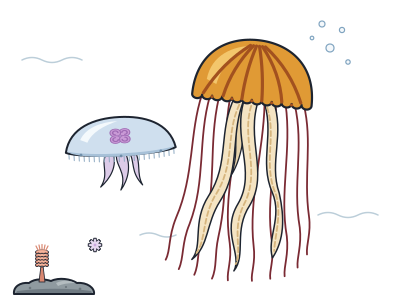
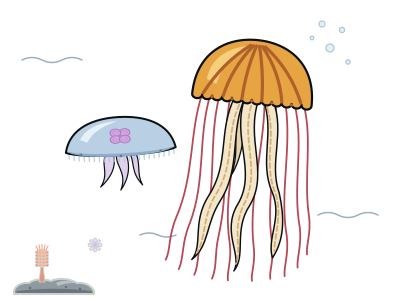
- Hydroids and siphonophoresThe most varied cnidarians: tiny polyps, floating colonies and jellies that can glow.
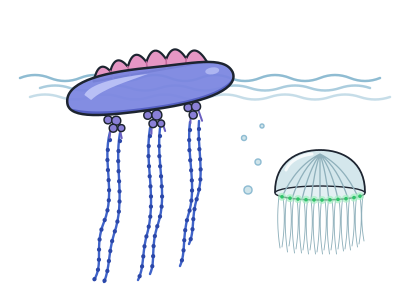
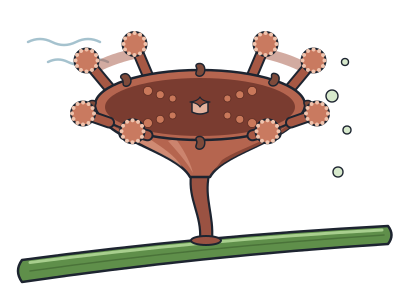
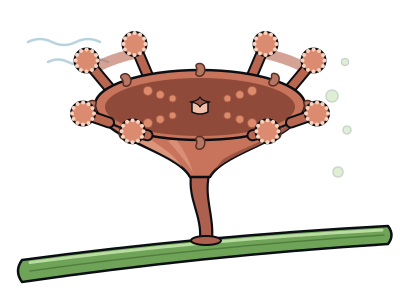
- Stalked jellyfishA jellyfish that never swims, living stuck to seaweed by a stalk like an upside-down flower.