A species
Salmon myxozoan
Henneguya salminicola
A jellyfish relative shrunk to a few cells, hiding in salmon and living without using oxygen
You and the salmon myxozoan meet in the Animals branch, shown at about 700 million years ago (on 1 November, in a calendar from life's shared ancestor to today).
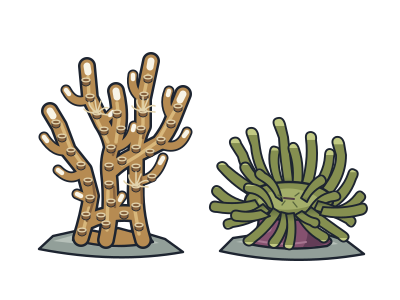
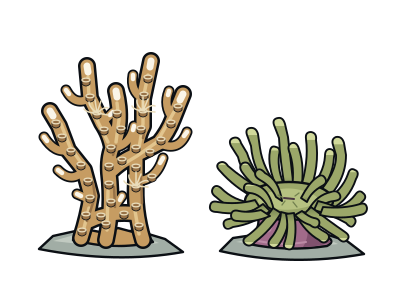
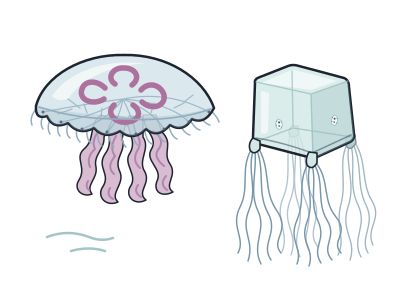
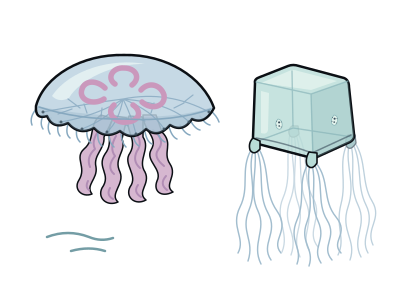
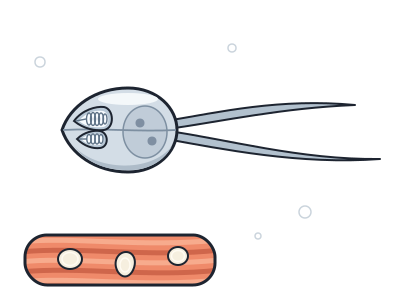
This tiny parasite is a relative of jellyfish, corals and sea anemones. That is hard to believe, because it is shrunk to just a handful of cells. Reports describe it as fewer than ten. The best clue is inside its spores. Each one has two small capsules holding a coiled thread, very like the stinging cells of a jellyfish. These capsules don't catch prey. Instead, they help the parasite latch on to a host.
In 2020, scientists found that it has no mitochondrial DNA. In other animals, mitochondria are tiny power stations that use oxygen to make energy. This parasite still has stripped-down versions of them, but it has lost the genes it would need to use oxygen in this way. It was the first animal known to have lost this DNA. Nobody yet knows exactly how it gets its energy. It may take energy-rich molecules from the fish cells around it.
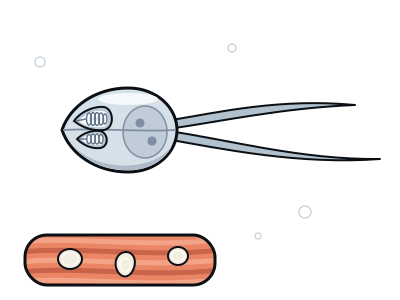
It lives in the muscle of Pacific salmon and trout in North America and Asia. That muscle already makes most of its energy without oxygen. Huge numbers of spores pack together into firm white lumps a few millimetres across, scattered through the flesh like tapioca pearls. They make the fish look unappetising, but they are harmless to people and pets, and the fish seem to be unharmed too.
Found in Alaska
It was described in 1919 from silver (coho) salmon caught in the Stikine River in south-east Alaska. Its cysts had already been seen in salmon from Kamchatka in 1914, but were put down to a different species.
A recent loss
A close myxozoan relative still has normal mitochondrial DNA. That suggests this parasite lost its mitochondrial DNA fairly recently, and that the loss is unusual even in its own group.
Tiny genomes
There are more than 2,000 known myxozoan species, and some have among the smallest genomes of any animal. One studied species has about 22.5 million DNA letters and fewer than a third as many genes as the small freshwater animal Hydra.