A species
Sea palm
Postelsia palmaeformis
A tiny palm tree made of seaweed that thrives where the biggest waves crash.
You and the sea palm meet in the Eukaryotes branch, shown at about 1.8 billion years ago (on 28 July, in a calendar from life's shared ancestor to today).
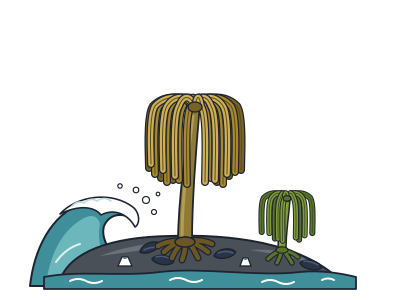
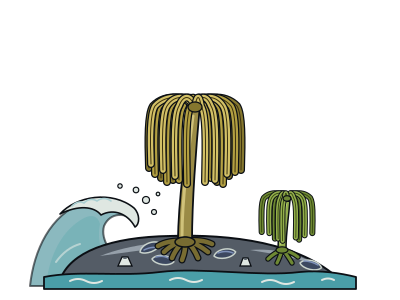
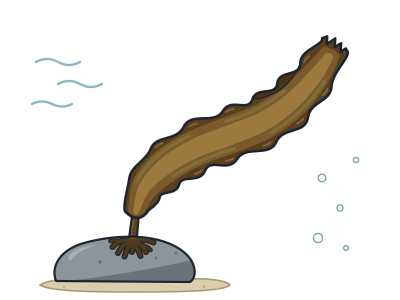
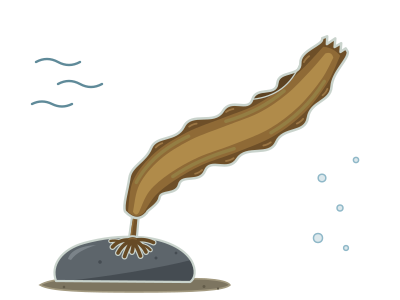
Picture a palm tree about as tall as an adult's knee, clinging to a rock where the biggest Pacific waves smash into the shore. That is the sea palm. It may look like one, but it is not a palm or any kind of plant. It is a kelp, a type of brown seaweed. Its relatives include giant kelp, bull kelp and kombu. Brown seaweeds are more closely related to tiny diatoms and water moulds than to land plants.
Its stalk is rubbery and hollow, not stiff like a tree trunk. When a wave hits, the stalk bends almost flat and then springs back upright. At the bottom, a root-like holdfast grips the rock so tightly that the rock often breaks before the holdfast lets go. On top sits a drooping crown of narrow blades, and one plant can have more than 100 of them.
Each sea palm lives for only about a year. Young plants appear in winter or early spring, grow fast and release spores in summer. At low tide, the spores drip off the blade tips onto the rock just a few metres away, so sea palms grow in crowded clumps. Mussels usually win the fight for space on the rock, so young sea palms mostly rely on winter storms tearing open gaps in mussel beds.
Green when young
Young sea palms are green. They turn olive to golden brown as they get older.
Named after an artist
Its scientific name honours Alexander Postels, an Estonian-born geologist and artist. The second part of the name means 'palm-shaped'.
Hit by a heatwave
Sea palm numbers dropped sharply along the coast during a marine heatwave from 2014 to 2016. They have come back only slowly because their spores travel such short distances.
Next to it on the tree
- Giant kelpLooks like a plant, is not one; grows up to half a metre a day.
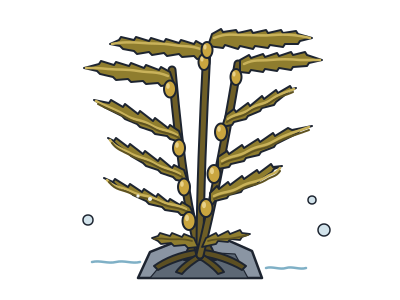
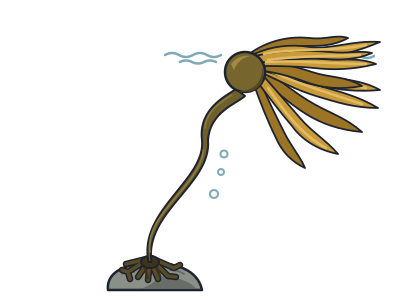
- Bull kelpA single gas-filled float, the size of a fist, holds up a crown of blades on a whip-thin stalk.
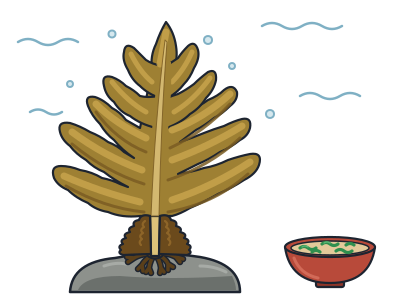
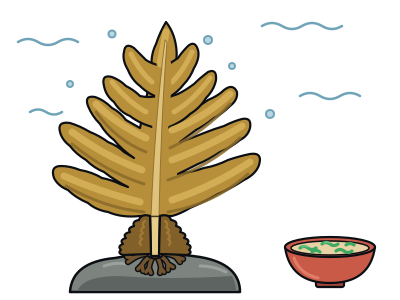
- KombuThe seaweed in Japanese soup stock, whose savoury taste led to the discovery of umami.
- WakameThe silky green ribbons in miso soup, farmed in Asia and now spreading around the world.