A species
Sea bunny
Jorunna parva
A tiny fluffy sea slug with two "ears" that make it look like a rabbit.
You and the sea bunny meet in the Two-sided animals branch, shown at about 580 million years ago (on 11 November, in a calendar from life's shared ancestor to today).
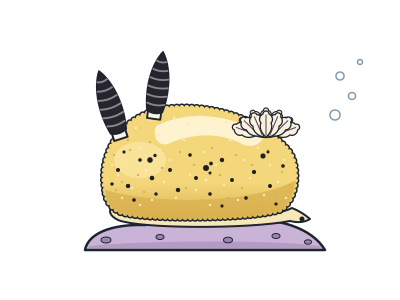
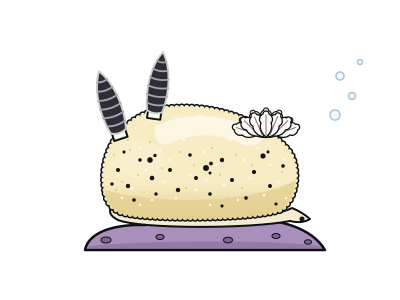
With two upright "ears" and a coat of soft-looking fuzz, this tiny animal looks just like a rabbit. But it is a sea slug. It is a mollusc, so its real relatives are snails, not bunnies. It belongs to the nudibranchs, a group of sea slugs that lost their shells during evolution. Most sea bunnies are less than about 2.5 centimetres long, about as long as the top joint of your thumb.
The "ears" are not for hearing. They are rhinophores, stalks that pick up chemicals in the water, a bit like smelling. Thin flaps on them give them extra surface, so the slug can detect very faint traces of food and mates. The "fur" is not hair. It is made of tiny knobs ringed by rods, mixed with needle-like hard bits. The fluffy "tail" at the back is a ring of feathery gills that it breathes with.
Sea bunnies glide slowly over the seafloor and reefs in warm, shallow seas across the Indo-Pacific, from South Africa to the central Pacific. They eat sponges and store the sponges' poisons in their own bodies. Experts say this makes them very toxic to predators. They may look cuddly, but the best way to enjoy one is to look and not touch.
Mostly yellow, not white
The white, black-spotted sea bunnies that became famous online are actually less typical. Most sea bunnies are yellow or orange.
Both mum and dad
Each sea bunny is both male and female at once. When two of them mate, they swap sperm with each other.
A tail that hides
The ring of feathery gills, about 11 to 14 small plumes, can be pulled fully back into a pocket in the body.