A species
Blue dragon
Glaucus atlanticus
A floating sea slug armed with stolen stings
You and the blue dragon meet in the Two-sided animals branch, shown at about 580 million years ago (on 11 November, in a calendar from life's shared ancestor to today).
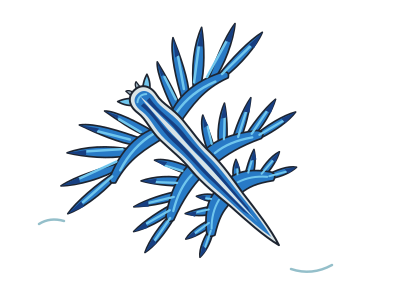
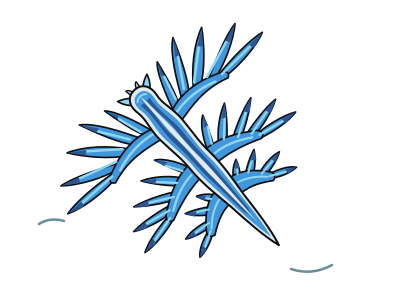
The blue dragon is a floating sea slug that eats Portuguese man o’ war and keeps their stings. It saves unused stinging capsules from its meals in special sacs at the tips of its finger-like projections. These stolen capsules help protect it from predators. It does not make the capsules itself.
Despite its dragon-like shape, this soft, shell-less animal belongs to the same broad group as garden snails and the other snails and slugs beside it on the tree. Its home is the ocean surface, where it floats upside down: belly towards the sky, back towards the water below. Wind and surface currents carry it along.
Its colours suit this upside-down life. The blue surface facing upwards blends with the sea when birds look down. Its silvery underside blends with the bright surface when fish look up from below. The two sides help hide the same small animal from different directions.
Six branches
It usually has three pairs of wing-like side branches, becoming shorter towards the tail.
The blue fleet
Its floating community includes Portuguese man o’ war, by-the-wind sailors, blue buttons and violet snails. Together, these drifting animals are called the ‘blue fleet’.
Known since 1777
The blue dragon was first scientifically described in 1777.