A species
Reishi
Ganoderma lingzhi
A shiny bracket fungus that looks varnished and has been prized in China for about 2,000 years
You and the reishi meet in the Fungi and animals branch, shown at about 1.3 billion years ago (on 10 September, in a calendar from life's shared ancestor to today).
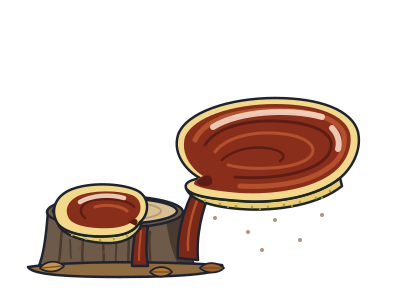
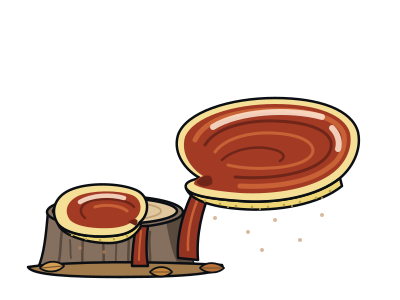
Reishi looks as if someone has painted it with varnish. Its cap is a glossy red-brown fan or kidney shape with faint curved bands. It sits on a short, shiny stalk that joins near the edge. In China, where it is called lingzhi, people have prized it for about 2,000 years. An ancient Chinese book of medicines mentions it, and in Chinese art it stands for health and long life.
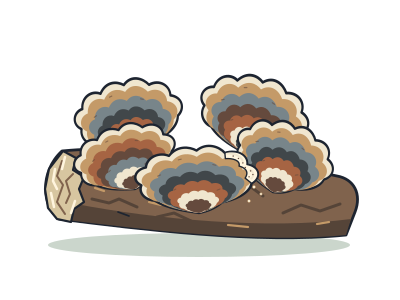
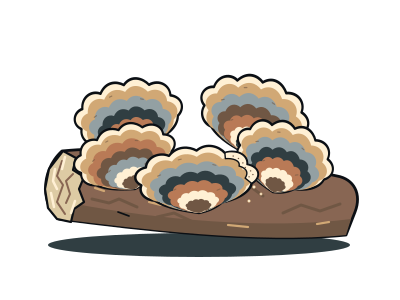
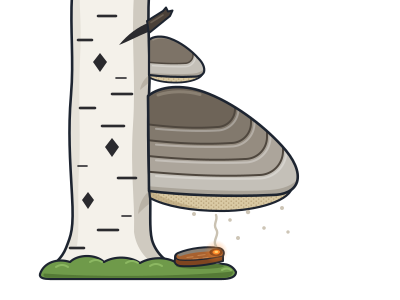
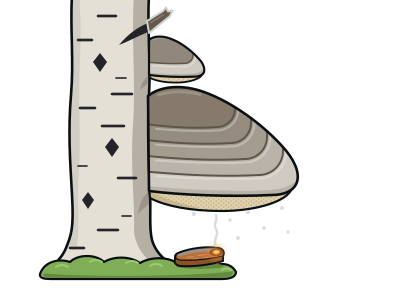
Reishi belongs to a big group of mostly bracket-shaped fungi with about 1,800 species. Turkey tail, chicken of the woods and tinder fungus belong to the same group. Turn a reishi over and you will find no gills. Instead, it releases its spores from tiny pores on a yellowish underside.
Reishi breaks down wood, even the toughest parts. In the wild it grows at the base of broadleaf trees and on old stumps in East Asia. Wild reishi is rare. Almost all reishi sold today is farmed on sawdust, grain, woodchips or logs.
It is tough and bitter, so it is not a mushroom for cooking. People dry it and take it as tea, powder or capsules. Science has not shown that it cures illness, and it can cause side effects.
The 10,000-year mushroom
In Japan reishi is called mannentake, which means '10,000-year mushroom'. The name is a nod to its link with long life.
Grown in damp air
Scientists in China first grew reishi caps artificially in the late 1960s. They found that the air must be very damp for a proper cap to form.
A case of mistaken identity
For a long time reishi was confused with a European relative that has a different scientific name. A DNA study found that 93% of grow-your-own kits sold under the European name actually held the East Asian reishi.