An extinct species
Psilophyton †
Psilophyton
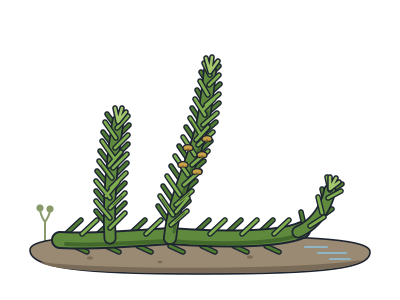
A spiky, leafless little plant that hints at what the shared ancestor of ferns and seed plants looked like.
Lived about 410–385 million years ago.
You and the psilophyton meet in the Eukaryotes branch, shown at about 1.8 billion years ago (on 28 July, in a calendar from life's shared ancestor to today).
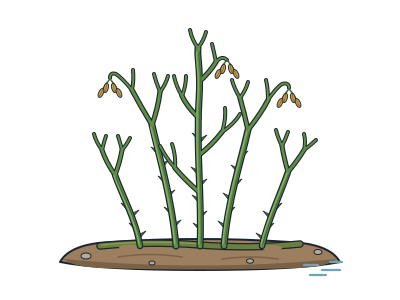
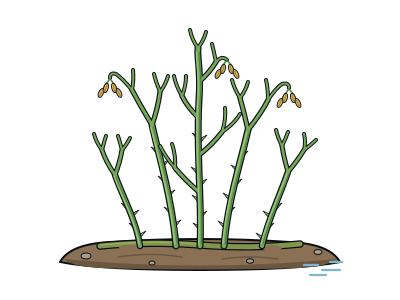
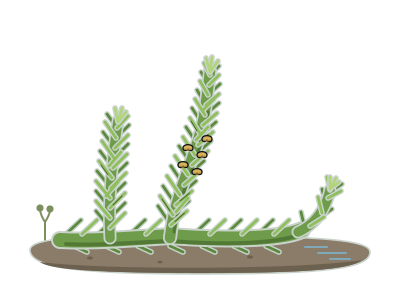
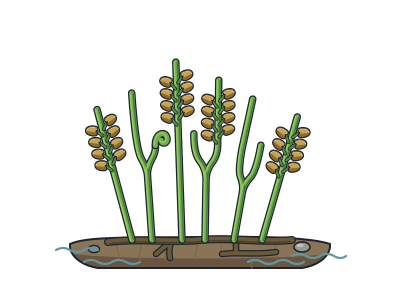
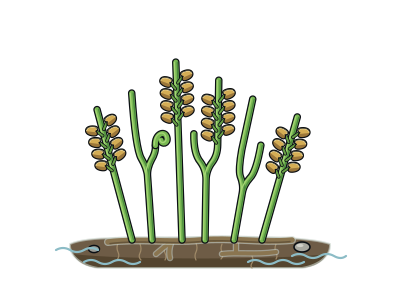
Picture a knee-high clump of bare stems. Each stem splits into a Y again and again, and some are covered in tiny spines. This plant had no leaves, no flowers and no seeds. Even so, it gives us a rough idea of what the shared ancestor of ferns and seed plants looked like. It sits near the start of the branch of the tree that today includes ferns, pine trees and roses.
It lived about 410 to 385 million years ago, long before the dinosaurs. Its upright stems were only a few millimetres thick and grew from a stem that crept along the ground. The biggest kind grew to about 60 cm, roughly knee height on an adult. Clusters of small spore capsules hung down from the tips of some branches. It grew in damp places near rivers that often flooded, probably in thick clumps.
Its fossils include flattened prints and mineral-filled stems that still show the inside of the stem. In one species, a central strand that carried water took up as much as a third of the stem's width. In some species a main stem had smaller side branches. Scientists see this as a step towards the leaves of ferns and seed plants. A species from Quebec described in the early 2020s had two kinds of spines, and these may have helped fend off plant-eating animals.
A famous mix-up
It was one of the first Devonian fossil plants ever found, described by the Canadian geologist John William Dawson in 1859. His drawing of it turned out to combine parts of three different plants.
Spines that helped anchor it
In fossils from New Brunswick in Canada, some outgrowths that look like spines grew mostly on the undersides of stems lying on the ground and responded to gravity. They seem to have worked like roots. They are the oldest known rooting structures in the fern-and-seed-plant line.
Packed with spore pods
In one well-studied species, a single cluster could hold up to 128 pairs of spore capsules. Each capsule was about the size of a grain of rice and split open along its length to release its dust-like spores.
Next to it on the tree
- Clubmosses and kinToday they are small and mossy, but their ancestors were giant trees that became our coal.
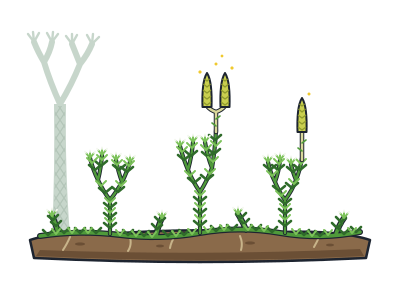
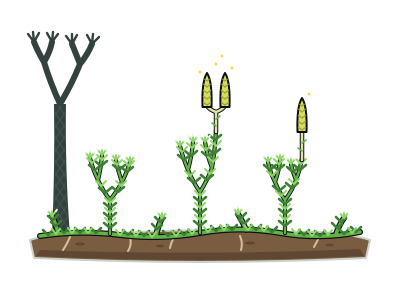
- BaragwanathiaOne of the first plants with leaves, a shaggy clubmoss-like stem from Silurian Australia.
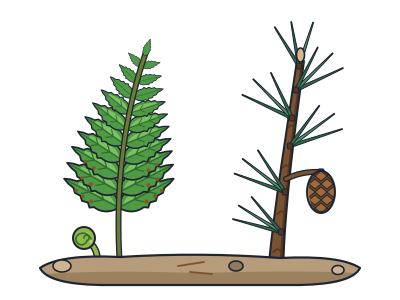
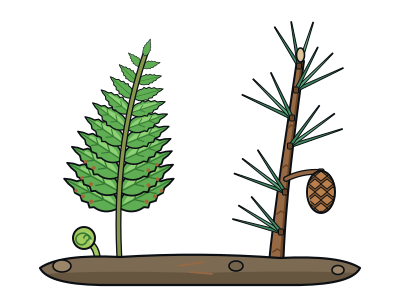
- Ferns and seed plantsFerns are closer cousins of pine trees and roses than of clubmosses.
- ZosterophyllumLeafless green stems topped with kidney-shaped spore cases, an early cousin of clubmosses.
- AsteroxylonA Rhynie chert plant covered in tiny scale leaves, from the line that leads to clubmosses.