An extinct species
Nipponites †
Nipponites mirabilis
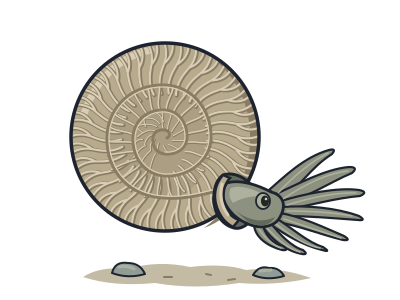
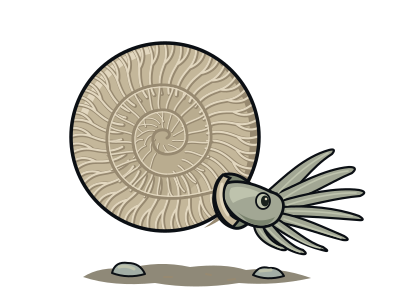
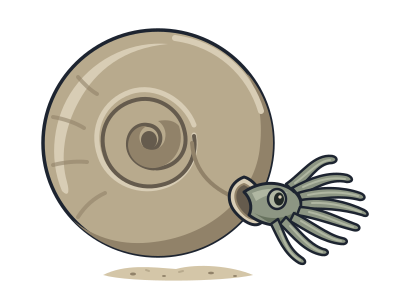
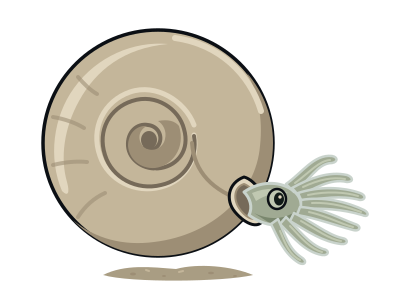
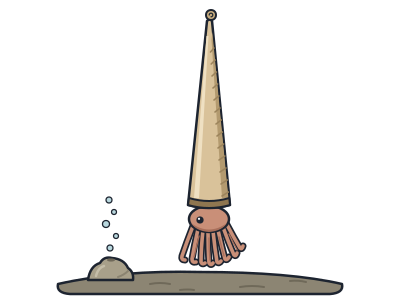
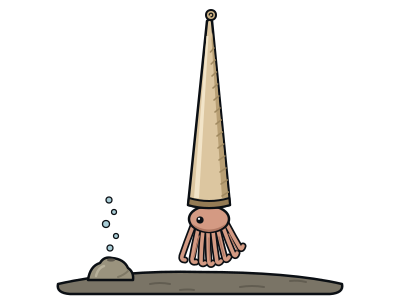
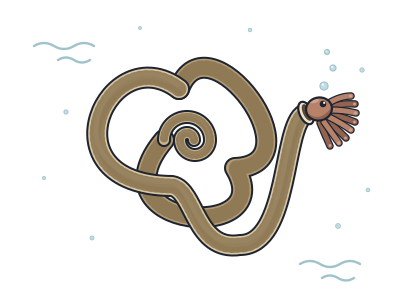
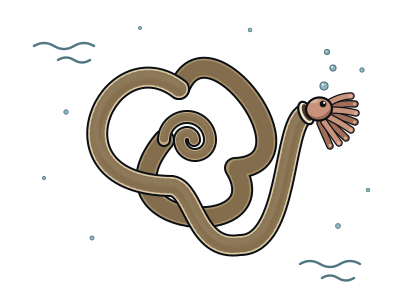
An ammonite whose shell grew in a tangle of U-bends, like a knot of garden hose.
Lived about 92–86 million years ago.
You and the nipponites meet in the Two-sided animals branch, shown at about 580 million years ago (on 11 November, in a calendar from life's shared ancestor to today).
Picture a garden hose dropped in a heap, all loops and U-bends. That is roughly what this ammonite's shell looked like. It lived in the seas around what is now Japan about 92 to 86 million years ago. Ammonites were shelled relatives of squid, octopuses and cuttlefish. They were more closely related to them than to the nautilus, even though their shells look alike.
Fossils show how the shell grew. When the animal was young, its shell made a few loose, flat coils. After that, the tube folded into a series of U-bends that wrapped back and forth around those first coils, switching between left-hand and right-hand turns. Fine ribs run across the shell, and each one marks where the opening once sat.
For a long time, scientists saw shells like this as strange mistakes of evolution. In fact, the tangle follows rules, and a few maths equations can describe it quite closely. In 2020, researchers built 3D computer models of the shell at 14 stages of growth. At every stage it could hover in the water, neither sinking nor rising. It probably drifted slowly in open water, turning gently to look for tiny floating food.
All ammonites died out at or soon after the great extinction about 66 million years ago, the same event that ended the non-bird dinosaurs.
A wonderful name
Its scientific name means roughly 'wonderful stone in Japan'. It was first described in 1904 by the Japanese palaeontologist Hisakatsu Yabe, from fossils found in Hokkaido.
Japan's Fossil Day
The Palaeontological Society of Japan uses this ammonite as its symbol. The society made 15 October 'Fossil Day' because that is the date the species was first described.
A family of knots
Scientists recognise four species of these knotted ammonites. They have been found in Japan, in eastern Russia (Sakhalin and Kamchatka) and in southern Oregon in the USA.