A species
Fried egg jellyfish
Cotylorhiza tuberculata
A Mediterranean jellyfish that looks just like a fried egg floating in the sea.
You and the fried egg jellyfish meet in the Animals branch, shown at about 700 million years ago (on 1 November, in a calendar from life's shared ancestor to today).
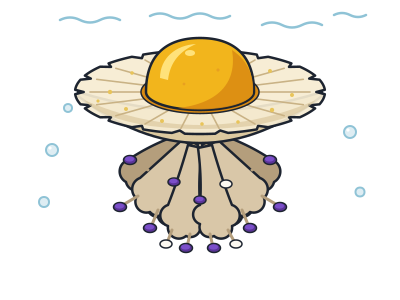
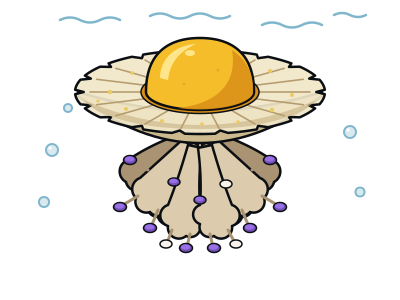
Imagine a fried egg drifting through warm Mediterranean water. That is what this jellyfish looks like. Its bell has a smooth, raised, golden-yellow dome in the middle, like a yolk. Around it is a paler, see-through rim, like the egg white. Large ones can be as wide as a dinner plate, and the biggest reach about 40 cm across.
It is a true jellyfish, in the same part of the tree as the moon jellyfish and the lion's mane. But unlike many of its relatives, it has no tentacles around the edge of its bell. Instead it belongs to the root-mouthed jellyfish. These have eight branched mouth arms covered in many tiny mouth openings, which strain small plankton from the water. On this species the frilly arms under the bell are often bright purple or blue.
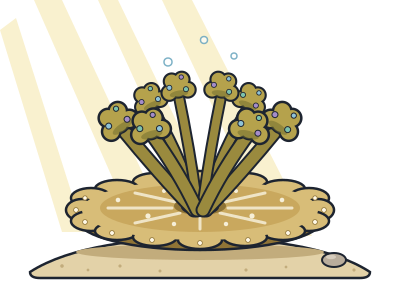
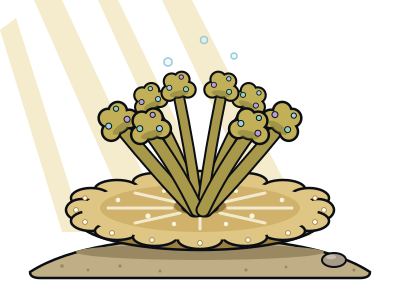
It also has tiny helpers. Small algae live inside its body and make food from sunlight. They give the jellyfish some of its colour and get nutrients from it in return. In one shallow Spanish lagoon, these jellyfish usually stay a metre or two below the surface, where their algae get plenty of light.
Good news for swimmers: its sting is very mild. Most people feel little or nothing, though sensitive people may get some itching.
A tiny winter form
For part of its life it is a tiny polyp fixed to the seabed, with a cup only about half a millimetre across. The polyps spend the winter there and only start making baby jellyfish after the water has stayed warm for a while.
A hiding place for fish
Young Mediterranean horse mackerel swim around these jellyfish and dart in among the mouth arms when they are frightened.
Almost all water
More than 95% of its body is water. Even so, large adults can weigh nearly 3 kg, about as much as a big bag of potatoes.
Next to it on the tree
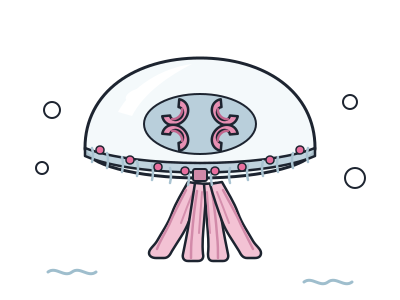
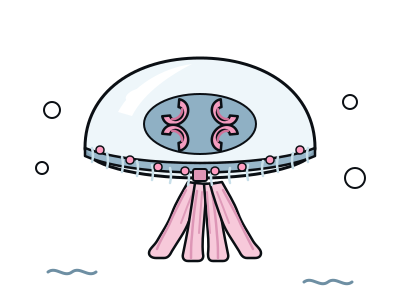
- Moon jellyfishNo brain, no heart, no bones, and 95% water, yet it has drifted the oceans for ages.
- Lion's mane jellyfishThe largest known jellyfish, with tentacles that can trail for over 30 metres.
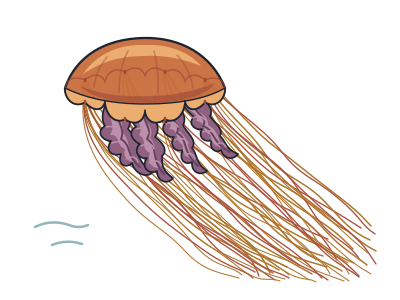
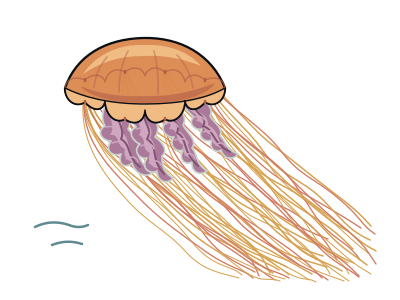
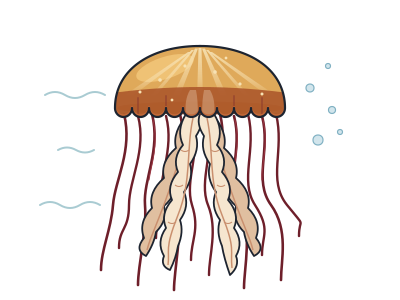
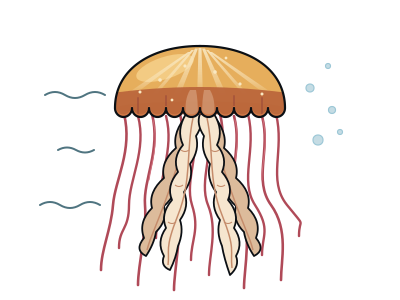
- Pacific sea nettleA golden-brown bell with long maroon arms, a favourite in aquarium jellyfish tanks.
- Upside-down jellyfishLies bell-down on the sand with its arms up, sunbathing so the algae inside it can feed it.