A species
Dumbo octopus
Grimpoteuthis bathynectes
A deep-sea octopus that flaps ear-like fins, like Disney's flying elephant.
You and the dumbo octopus meet in the Two-sided animals branch, shown at about 580 million years ago (on 11 November, in a calendar from life's shared ancestor to today).
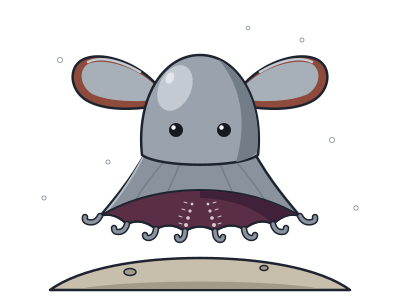
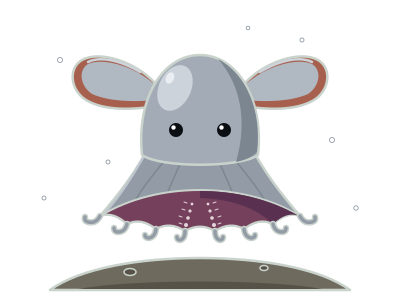
Imagine an octopus that swims by slowly flapping two big, ear-like fins, just like Disney's flying elephant Dumbo. That is this animal. It is a true octopus, a relative of the common octopus and the giant Pacific octopus, but it looks and lives very differently.
Octopuses come in two main groups. The familiar ones have no fins, and at most tiny leftover bits of shell. Dumbo octopuses belong to the finned group, and this species still has a small, U-shaped shell hidden inside its body that supports its fins. Finned octopuses also have no ink sac, so they cannot squirt ink.
This species is known only from two deep, flat stretches of seafloor off Oregon in the USA, about 3 to 4 kilometres down. Its head and body are grey, its fins have reddish-brown back edges, and the web of skin between its arms is dark purple to reddish-brown. Scientists know of just 13 of them.
Dumbo octopuses swim by flapping their fins and steering with their arms. They neither sink nor float, so they can also just drift. Most are about 20 to 30 centimetres long, about the length of a school ruler.
Deepest of all octopuses
Dumbo octopuses are the deepest-living octopuses known. In 2019, cameras in the Java Trench near Indonesia filmed one nearly 7 kilometres down. That beat the old record by more than 2 kilometres.
Ready to breed any time
Female dumbo octopuses carry eggs at different stages of development at the same time. This means they can breed whenever they get the chance, with no fixed breeding season.
No rasping tongue
Most molluscs have a rough, tongue-like feeding tool called a radula. This species has none.
Next to it on the tree
- Common octopusThree hearts, blue blood, and arms that taste and think for themselves.
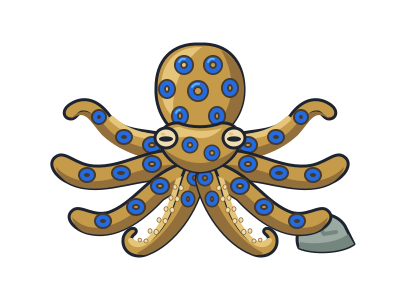
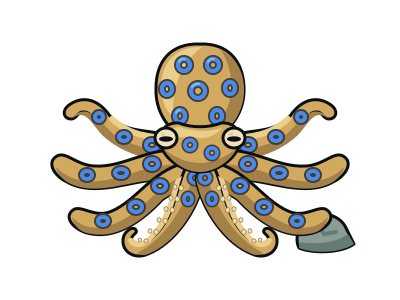
- Blue-ringed octopusSmall enough to fit in a palm, it flashes blue rings as a warning of deadly venom.
- Mimic octopusImpersonates lionfish, flatfish and sea snakes by changing its shape and colour.
- Giant Pacific octopusThe largest octopus, with arms spanning several metres, yet it lives only about four years.
- Greater argonautA female octopus that builds a paper-thin shell as a floating cradle for her eggs.