An extinct species
Cooksonia †
Cooksonia
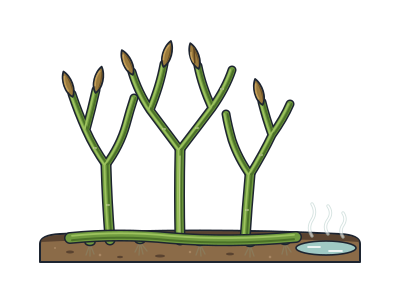
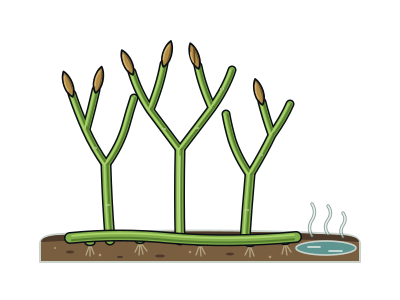
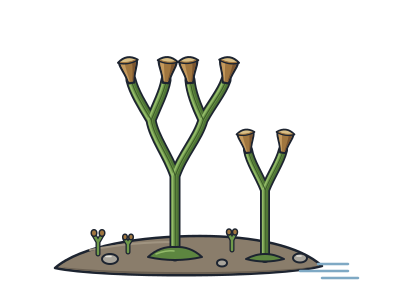
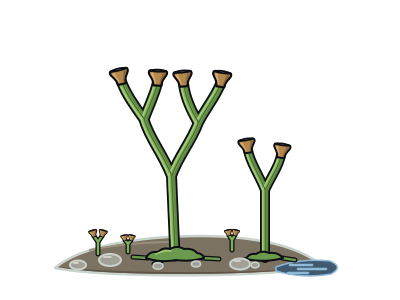
A tiny forking stalk with no leaves, among the first upright plants on land
Lived about 433–393 million years ago.
You and the cooksonia meet in the Eukaryotes branch, shown at about 1.8 billion years ago (on 28 July, in a calendar from life's shared ancestor to today).
Picture a thin stalk about the size of a matchstick, standing upright on damp mud. It had no leaves, no roots and no flowers. This was one of the first upright plants on land. It lived about 433 to 393 million years ago, long before the dinosaurs. There were no trees then, and the land looked mostly bare.
Fossils show a smooth stalk that split into a Y a few times. Each tip carried one spore capsule. In many fossils the capsule is shaped a bit like a tiny trumpet with a lid, and the lid broke apart to let the spores out. Most of these plants were only a few centimetres tall. One fossil from England, kept in Wales, is about 12 millimetres high, about the length of a fingernail.
Its family story is the surprising part. It was not a moss and not a fern. Some fossils have a dark stripe down the middle of the stalk, and in one species scientists found tubes inside the stem with the patterned walls of water-carrying cells. So at least some of these plants had early plumbing. That puts them near the very start of the vascular plant line, the group that later came to include ferns, trees and flowering plants.
The fossils are dark films on grey rock. Its colour, probably green, and whatever grew at the base are not preserved, so artists have to make an educated guess.
Named after a scientist
The name honours the plant fossil expert Isabel Cookson, who collected specimens in 1934. William Henry Lang named the plant after her in 1937.
Hidden in a museum collection
A fossil almost 6 cm long, from about 432 million years ago, sat unrecognised in the National Museum in Prague for about 150 years. It is the oldest known land plant fossil big enough to see without a microscope.
Washed out to sea
Fossils have turned up in Britain, Ireland, Czechia, Poland and Bolivia. Many are in rocks that formed in shallow seas, so the plants were probably washed in from nearby land.
Next to it on the tree
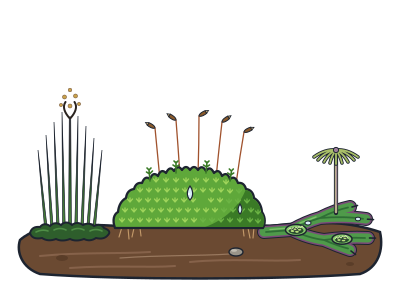
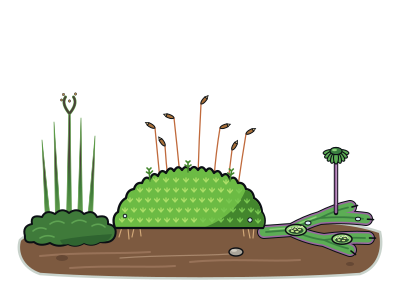
- Mosses, liverworts and hornwortsSmall plants without pipes that hug damp ground and keep the oldest land-plant habits.
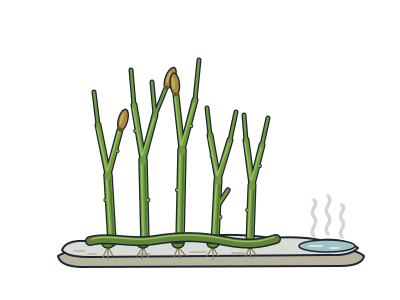
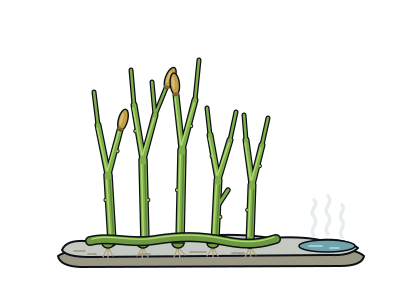
- Rhynie chert plantPreserved cell by cell in hot-spring rock, giving a real snapshot of a 400-million-year-old landscape.
- Vascular plantsPlants with internal pipes, which let them stand tall and grow into the first forests.
- AglaophytonA Rhynie chert plant with water tubes simpler than true veins, caught halfway to being vascular.