A species
Golden chanterelle
Cantharellus cibarius
Golden caps, an apricot scent and ridges instead of gills.
You and the golden chanterelle meet in the Fungi and animals branch, shown at about 1.3 billion years ago (on 10 September, in a calendar from life's shared ancestor to today).
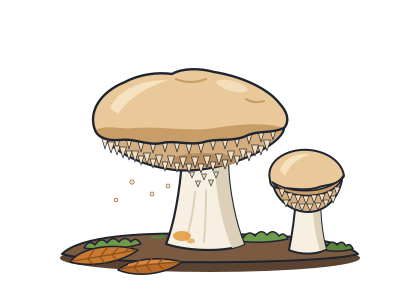
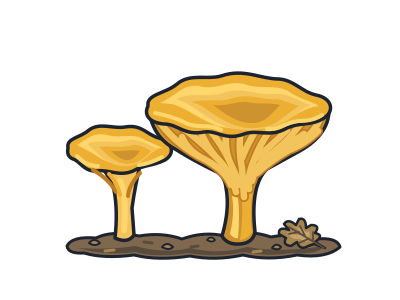
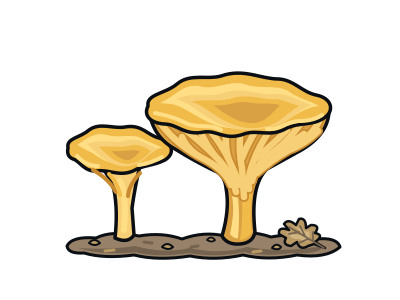
Golden chanterelles have a fruity scent often compared with apricots. Their yellow-to-orange caps have wavy edges and a funnel-like shape. Underneath are thick, rounded ridges rather than true gills: the thin blades found beneath many other mushrooms. These ridges fork and run down the stalk. Despite its familiar mushroom shape, this fungus belongs to the chanterelle branch within the wider mushrooms-and-brackets group, which also includes turkey tail.
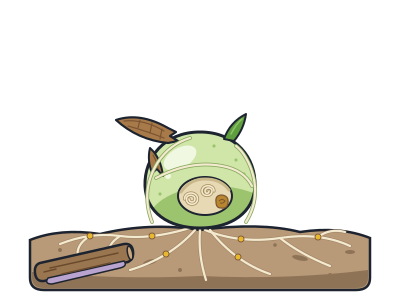
Its connection with trees is just as important as its shape. Rather than simply feeding on dead wood, it forms a partnership with living roots. Fine fungal threads below ground collect water and minerals, while the tree supplies food made using sunlight. Both partners benefit. The mushroom we notice above ground is the part used for reproduction, not the whole fungus.
Look for it on woodland soil in Britain, Ireland and mainland Europe. It grows in both broadleaved and conifer woods, often on acidic ground. Reported tree partners include oak, chestnut and hazel.
Pale spores
Its spores look pale yellow to creamy white when gathered together.
Named in 1821
Swedish mushroom expert Elias Magnus Fries described and named the species in 1821.
Another name
Girolle is another common name for the golden chanterelle.