An extinct species
Tylosaurus †
Tylosaurus proriger
A sea-going lizard whose strange snout inspired a disputed idea.
Lived about 88–78 million years ago.
You and the tylosaurus meet in the Amniotes branch, shown at about 320 million years ago (on 4 December, in a calendar from life's shared ancestor to today).
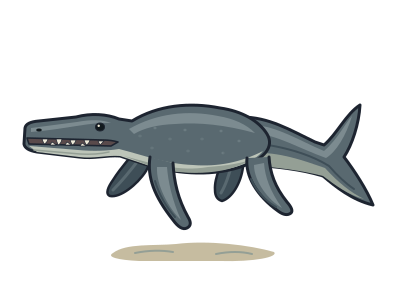
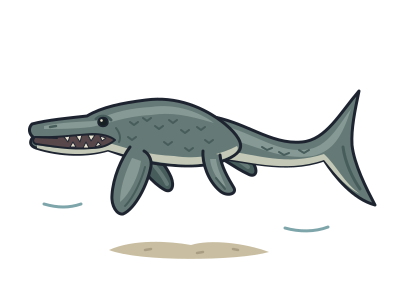
This sea-going lizard had a long, bony snout that projected beyond its front teeth. Some scientists suggested it rammed prey, but others questioned that idea. It was a mosasaur, part of the same broad reptile group as living lizards and snakes. Mosasaurus was a relative, not another name for this animal.
It lived about 84 million years ago, judging from the age of many known fossils. One home was the warm Western Interior Seaway, which covered central North America. This sea linked the Gulf of Mexico with the Arctic Ocean. Places now far inland were once part of its underwater world.
Fossils preserved pieces of that world rather than a complete picture. The original specimen included part of a skull, a jaw about 1.5 metres long and several backbone bones. That enormous jaw was only one piece of a much larger animal.
Names inspired by its nose
Its two-part scientific name meant ‘knob lizard’ and ‘prow bearing’. Both parts referred to its projecting snout.
A meal preserved
Remains in the stomach area of a Smithsonian specimen showed that it had eaten another kind of marine reptile.
Lost only on paper
Its original fossil was mistakenly reported lost in 1967. A museum worker’s social-media photograph later helped researchers recognise it at Harvard.