A species
Jelly-ball radiolarian
Thalassicolla nucleata
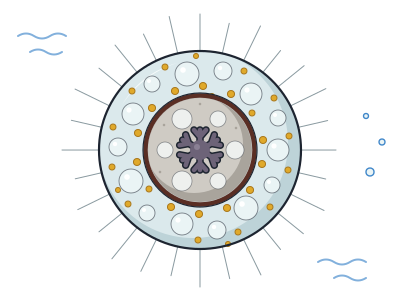
One cell as big as a peppercorn, with a garden of golden algae inside
You and the jelly-ball radiolarian meet in the Eukaryotes branch, shown at about 1.8 billion years ago (on 28 July, in a calendar from life's shared ancestor to today).
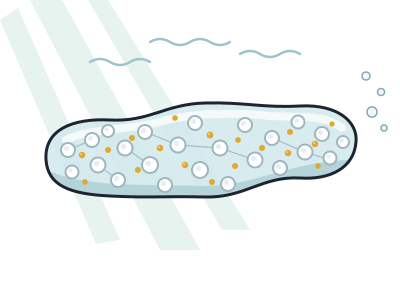
This little jelly ball is just one cell. At about 3 millimetres across, though, it is big enough to see without a microscope. That is roughly the size of a peppercorn. Most cells are far too small to see, and even most of its radiolarian relatives are only a fraction of a millimetre wide.
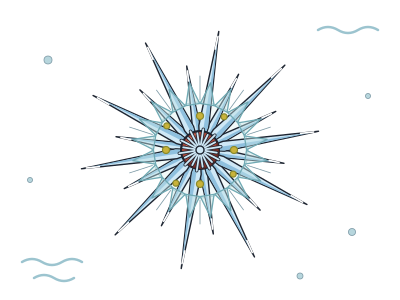
Inside its clear, bubbly jelly it farms tiny golden algae. The algae use sunlight to make sugars, and some of that food passes to their host. The jelly-ball still hunts too. It catches prey with very fine threads that spread out from its body like a faint halo.
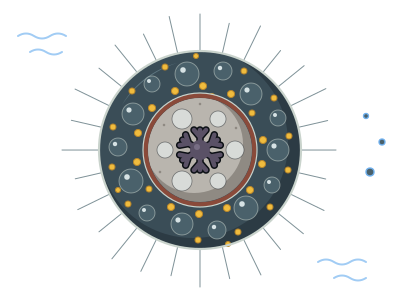
In lab tests, a single touch makes it give off a blue flash that lasts about five seconds. The light comes from many tiny points in its outer jelly. Tests on glowing radiolarians suggest the light does not come from the algae. Most likely, the radiolarian makes the light itself.
On the tree of life it sits among the radiolarians, beside a colonial relative whose cells share one jelly and a group called acantharians. Further out, its relatives include kelp and diatoms. It has no skeleton at all. It drifts with the currents in the sunlit surface water of warm and temperate oceans around the world.
A partner that gets around
Its algal partner can also live free in the sea. The same alga has been found inside other radiolarians and even in the by-the-wind sailor, a floating relative of jellyfish.
Picked out by hand
For one study, scientists towed a net slowly through the sea off Hawaii, then picked out each cell one by one under a microscope.
A surprise passenger
Scientists studying its genes found a second, unexpected tiny organism living inside it. It is probably a parasite.