A group of species
Acantharians
Acantharia
Single cells that grow a star of firework crystal
You and acantharians meet in the Eukaryotes branch, shown at about 1.8 billion years ago (on 28 July, in a calendar from life's shared ancestor to today).
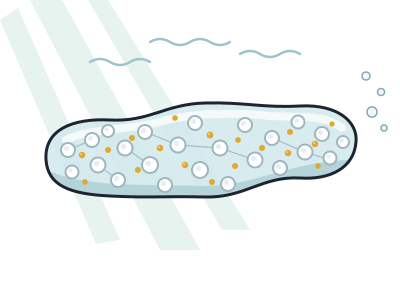
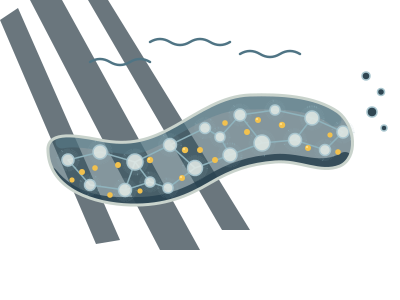
Acantharians are the only living things known to build a skeleton from celestite. People mine this same crystal for strontium, which gives fireworks their red colour. Yet each acantharian is just a single cell, not an animal. Most are about 0.2 to 1 millimetre across, so they look like a speck of dust to the naked eye.
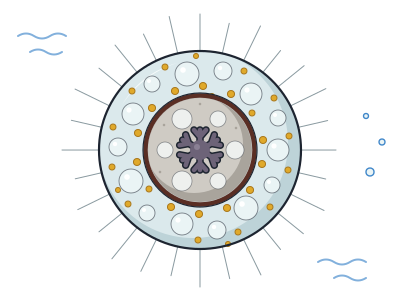
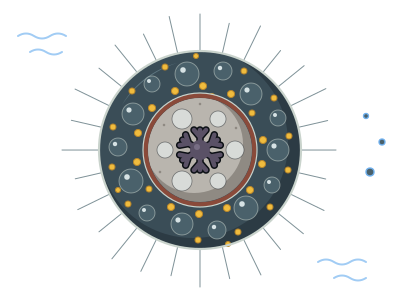
They belong to the radiolarians, tiny ocean drifters known for their beautiful skeletons. Their relatives include the colonial radiolarian shown beside them. Most other radiolarians build their skeletons from silica, a glass-like material. Acantharians are the only ones that build a whole skeleton from a completely different mineral.
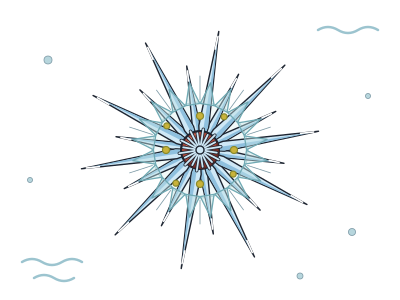
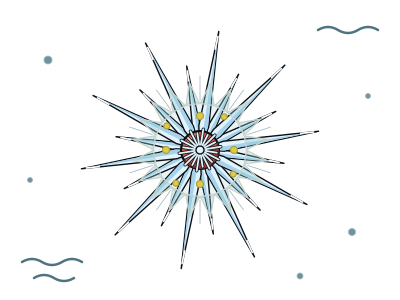
The classic acantharian is a sparkling star of 20 crystal spines pointing out from its centre. The spines follow a strict pattern, like points on a globe: four near each pole, four more in each half, and four around the middle like an equator. Tiny threads on each spine pull the cell's jelly-like outer layer in and out, helping it float higher or sink.
They drift in the upper 300 metres of oceans all over the world, and are most common in warm, open seas far from the coast.
A heavenly name
Celestite gets its name from a Latin word meaning 'heavenly' or 'of the sky', because some crystals are a pale sky blue.
Gardens inside
About half of wild acantharians carry tiny algae living inside them. The algae make food from sunlight, and sometimes they make as much food as their host needs, or even more.
Express lift to the deep
In the North Atlantic, some acantharians form tiny cysts for reproducing that sink about 500 metres a day. Some were caught 2,000 metres down, deeper than four Empire State Buildings stacked up.