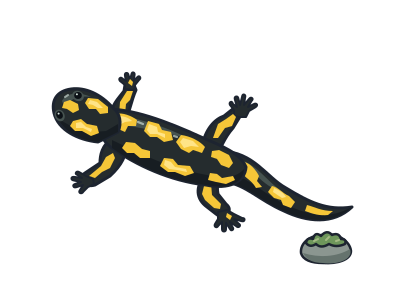
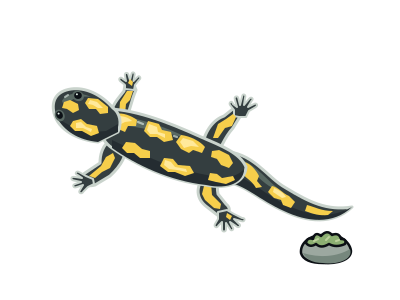
A group of living things
Salamanders and newts
Caudata
Tailed amphibians, from finger-sized newts to people-sized giants.
This branch is shown at about 170 million years ago; its age is a rough estimate.
You and salamanders and newts meet in the Four-limbed animals branch, shown at about 350 million years ago (on 1 December, in a calendar from life's shared ancestor to today).
From finger-sized newts to giants longer than many people are tall, these amphibians keep their tails as adults. Most salamanders measure about 5–15 centimetres from head to tail: roughly finger-sized to hand-length. Chinese giant salamanders can reach about 1.8 metres, but these are exceptional giants, not the usual size.
Their long bodies and tails may remind you of lizards. Yet salamanders belong with frogs, toads and caecilians among the amphibians, not the reptiles. Their skin has no reptile-like covering of scales. Every newt is a salamander, but not every salamander is a newt. Axolotls, olms and hellbenders belong here too.
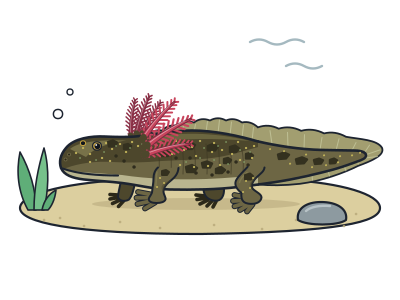
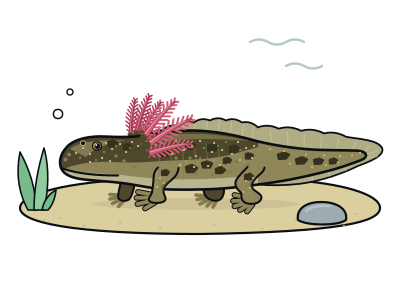
Some members spend their whole lives underwater. Others live on land, sheltering beneath logs or rocks, in burrows or in shady woodland. Axolotls normally keep their feathery outside gills—the parts that take oxygen from water—even as adults. There is no single way of life that fits this whole group.
Breathing without lungs
Some salamanders have no lungs. As adults, they take in oxygen through their moist skin and the lining of their mouth and throat.
Front legs first
In many salamanders, the young grow front legs before back legs—the opposite order from frogs and toads.
Growing a limb again
An axolotl can regrow a lost limb, including its bones, muscles and skin.
Inside salamanders and newts
- AxolotlA salamander that never grows up and can regrow legs, and even parts of its heart.
- OlmsCave salamanders with slow lives: a long-term study predicted that some could live beyond a century.
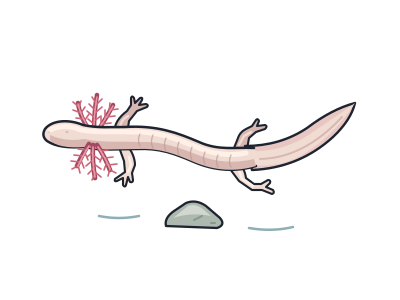
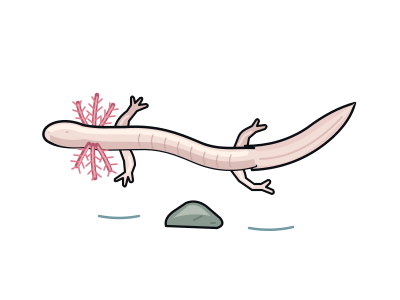
- Giant salamandersThe largest amphibians alive, ancient-looking river dwellers that have changed little in 160 million years.
- Newts and fire salamandersMany have toxic skin and bright warning colours, and newts return to ponds each spring to breed.
- Red-backed salamanderHas no lungs at all and breathes entirely through its skin under logs and leaves.
- Spotted salamanderIts eggs turn green with algae living inside them, a rare sun-powered partnership with a backboned animal.
- Greater sirenAn eel-like salamander with tiny front legs, no back legs and feathery gills.
Next to it on the tree
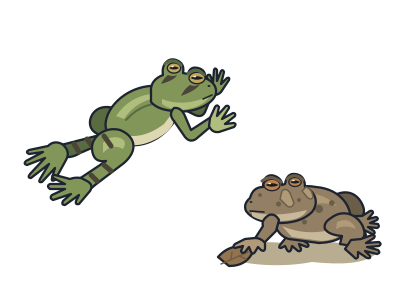
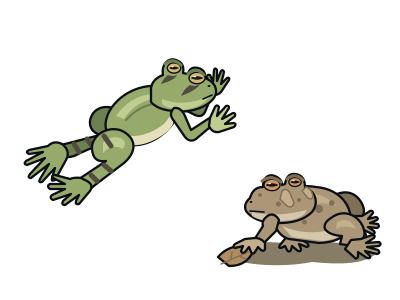
- Frogs and toadsEvery toad is a frog: a body plan built for jumping that has barely changed in 200 million years.
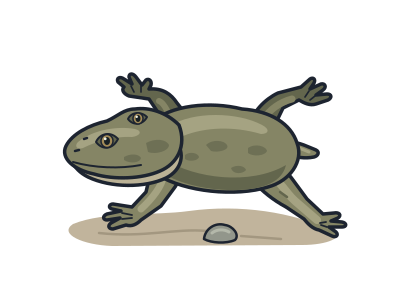
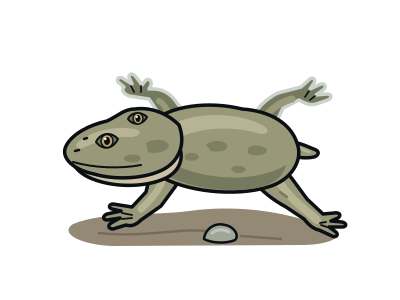
- TriadobatrachusAn early frog relative with separate tail bones and a skeleton better suited to walking than powerful leaps.
- CaeciliansLegless, burrowing amphibians that look like big earthworms and are rarely seen by anyone.
- EocaeciliaAn early caecilian relative that still had tiny legs, linking caecilians to legged ancestors.